
Buying Your First Home in Burlington, Ontario: Where the Entry Points Still Are — and What to Refuse to Compromise On
Burlington is not a first-time buyer city by reputation. It sits between Oakville and Hamilton on the price spectrum, closer to Oakville than most first-timers want to hear, and the conversation usually ends there. But that's the wrong frame. Burlington does have entry points for first-time buyers — they're just not obvious, they require trade-offs that need to be made consciously rather than by accident, and they disappear quickly when they appear. This guide maps exactly where the sub-$900k opportunities are in Burlington right now, how to stack your FHSA and RRSP to maximise your down payment, and how to do the GO commuter math honestly — because that number affects whether Burlington is financially rational for your situation or whether you should be looking at Hamilton instead.
Not sure if Burlington works for your budget and commute? Reply to this email or book a free 15-minute call with Nik — we'll run the actual numbers for your income, your savings, and your workplace before you spend a weekend at open houses in the wrong city.
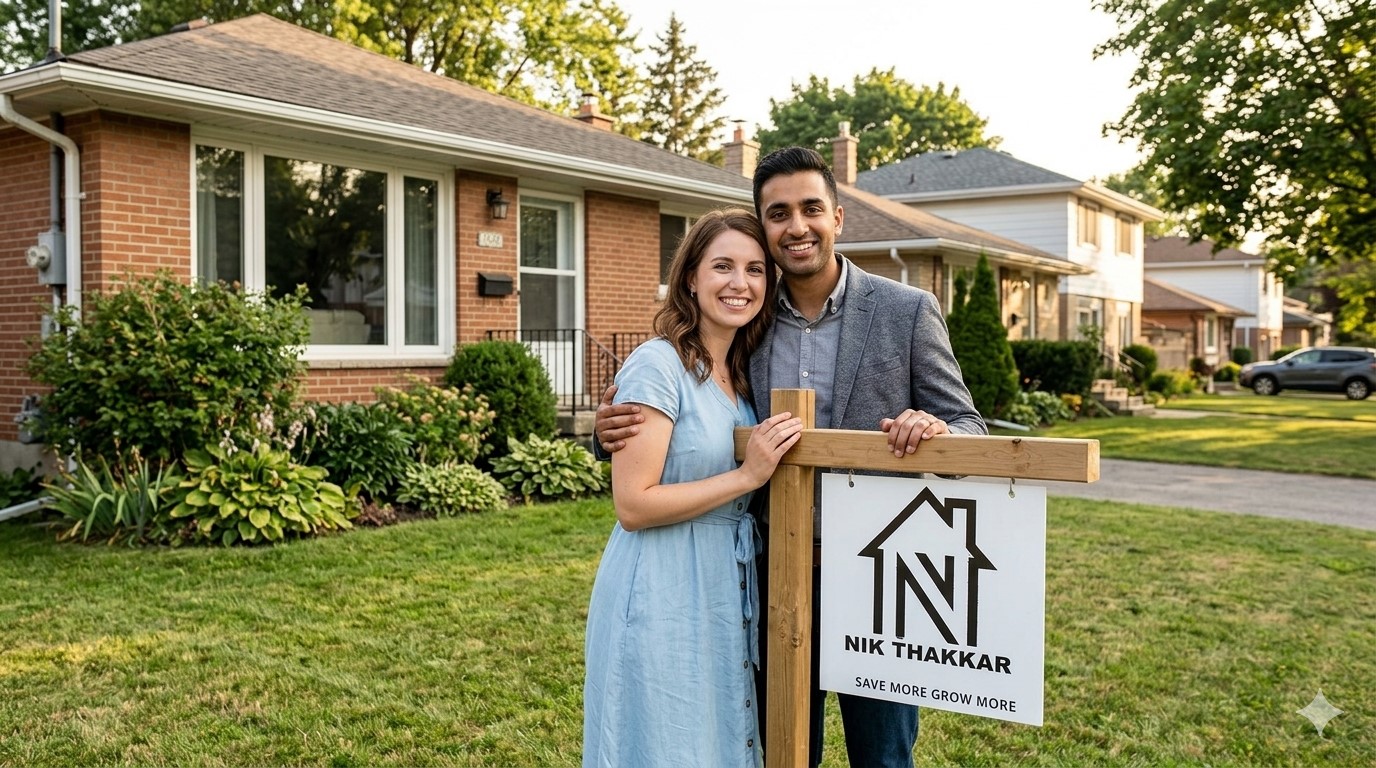
Step 1: The Reality Check — What Burlington Actually Costs for First-Time Buyers
Burlington's average detached home price is north of $1.2M. That number ends the conversation for most first-time buyers, and correctly so — a $1.2M purchase requires $240,000 down (20%) to avoid CMHC insurance premiums on the full amount, which immediately disqualifies a large portion of the buyer pool. But Burlington's average doesn't tell the full story, because averages are pulled up by Roseland custom builds and Old Burlington lakefront properties that have nothing in common with what a first-time buyer would actually purchase. The operative question is not "what is Burlington's average?" It's "what does a liveable first home cost in Burlington, and what does it look like?"
The honest answer: in Burlington, Ontario, a first-time buyer with a budget under $900,000 is looking at condos, stacked townhomes, or older bungalows that need work. Freehold detached homes under $900k exist, but they are rare, they move within days, and they typically require either significant renovation or a location trade-off that not every buyer can accommodate. Understanding that reality before you start searching is what separates buyers who close efficiently from buyers who spend eight months making offers on homes they can't afford and burning out before they find anything. The full Ontario first-time buyer strategy guide covers the process from pre-approval through closing — useful context before you narrow your city.
Step 2: Where Burlington's Sub-$900k Entry Points Actually Are
They exist — but they're specific, and each comes with a trade-off that needs to be named clearly before you decide whether it works for you.
- Aldershot bungalows — $850,000–$975,000 (unrenovated)
The original 1950s and 1960s bungalows in Aldershot's L7T postcode are Burlington's most accessible freehold detached entry point for buyers with renovation tolerance. These are 1,000–1,400 sq ft homes on 55-foot lots with original kitchens, dated bathrooms, and mechanical systems that may need updating. The trade-off is renovation effort and capital — plan for $80,000–$130,000 in improvements over 2–3 years. What you get in return: a freehold detached home in a GO-walkable neighbourhood with the Royal Botanical Gardens at the back door and real resale liquidity. The renovation is the price of admission. If you can pay it, this is Burlington's best first-time buyer value play. - Stacked and back-to-back townhomes — $700,000–$875,000
Stacked townhomes (two-storey units sharing a common footprint with the unit above or below) and back-to-back townhomes (freehold or condo-corp units without a rear yard) exist in several Burlington neighbourhoods, particularly around the Palmer and Headon Forest areas in the northwest and some pockets of east Burlington. These are the most accessible price tier, and they come with the trade-offs that go with that: no rear yard or a very small one, shared walls, potentially higher condo fees if on a condo corporation, and street-facing parking rather than a private driveway. For buyers who spend weekdays at work and weekends off-property, the yard trade-off is genuinely manageable. For buyers with dogs, young children, or strong preferences for outdoor space, it isn't. - Condos (1 and 2-bedroom) — $490,000–$750,000
Burlington's condo market is smaller than Mississauga's or Toronto's, but it exists and it provides the most accessible price entry in the city. Buildings are concentrated along Lakeshore Road, New Street, and around the GO stations. The trade-off: condos in Burlington have faced the same headwinds as GTA condos broadly — rising maintenance fees, slow appreciation relative to freehold, and some resale liquidity challenges in certain building profiles. If you are buying a Burlington condo as a genuine 5–7 year hold with the intention of building equity and selling into the freehold market, the math can work. If you are buying a condo in Burlington hoping for 15% appreciation in 18 months, you're likely to be disappointed. - Older semis in Brant Hills and central Burlington — $850,000–$975,000
Brant Hills, a mid-Burlington neighbourhood, and some central Burlington streets have older semi-detached homes from the 1970s and 1980s that occasionally list in the $850,000–$975,000 range. These offer freehold ownership, more square footage than a stacked town, and real backyards — at the cost of older mechanical systems and the design language of their era. School catchments in Brant Hills are worth verifying by specific street before purchasing; they vary enough that it matters for families with school-age children.
Step 3: The FHSA + RRSP Stack — The Down Payment Help Most First-Time Buyers Don't Maximise
The two federal government programs that exist specifically to help first-time buyers build down payments are systematically under-used — either because buyers don't know about them, don't start contributing early enough, or don't understand how to use them together. Here is the stacking math in plain language.
- The First Home Savings Account (FHSA): You can contribute up to $8,000 per year, to a lifetime maximum of $40,000. Contributions are tax-deductible (reducing your taxable income, like an RRSP), and withdrawals for a qualifying first home purchase are completely tax-free (like a TFSA). This is genuinely the best savings vehicle the Canadian government has ever created for first-time buyers — it combines the upfront tax benefit of an RRSP with the tax-free withdrawal of a TFSA. If you haven't opened an FHSA yet and you're planning to buy within the next 3 years, open one today. Unused room doesn't carry forward indefinitely.
- The RRSP Home Buyers' Plan (HBP): If you have existing RRSP savings, you can withdraw up to $35,000 per person ($70,000 per couple) tax-free for a qualifying first home purchase, with a 15-year repayment window. Combined with the FHSA, this gives a single buyer access to $75,000 in government-advantaged savings, and a couple access to $150,000 — a meaningful contribution toward the down payment on an Aldershot bungalow or a Burlington townhome at current prices.
- First-Time Home Buyers' Tax Credit: A federal tax credit of $10,000 on the purchase of a qualifying first home, generating approximately $1,500 in federal tax savings in the year of purchase. Small relative to the down payment numbers above, but free money that requires nothing more than filing correctly.
- Ontario Land Transfer Tax Rebate: First-time buyers in Ontario receive a rebate on the provincial land transfer tax of up to $4,000, effectively eliminating the LTT on purchases up to approximately $368,000 and reducing it on higher-priced homes. On an $875,000 Burlington purchase, the provincial LTT would be approximately $13,475 before the rebate — you'd receive $4,000 back, reducing your net LTT to approximately $9,475. This doesn't change the purchase decision, but it's a closing cost reduction that should be factored into your budget.
The practical takeaway: a couple who has been maximising their FHSA for two years and has $50,000–$60,000 in combined RRSP savings can potentially assemble a down payment of $130,000–$150,000 without touching conventional savings. On an $875,000 Burlington townhome, that's a 15–17% down payment — close enough to the 20% threshold that a small top-up from savings or a gift from family gets you there and eliminates CMHC insurance on the full amount. That math changes the feasibility picture for Burlington meaningfully.
Step 4: The GO Commuter Math — What Living in Burlington and Working in Toronto Actually Costs
Burlington is a GO commuter city. If you're buying here and working in Toronto or Mississauga, the commute cost is a real monthly expense that needs to factor into your budget alongside the mortgage payment. Here is what the numbers actually look like.
- Burlington GO to Union Station: Approximately 45–50 minutes on Lakeshore West express service. This is one of the most comfortable and time-efficient GO commutes in the network — the trains are frequent during peak hours, the route is non-stop from Burlington GO for many services, and Union Station is the final destination. Monthly GO pass from Burlington: approximately $285–$320 per person depending on current Metrolinx pricing. For a couple where both partners commute: $570–$640 per month in transit costs.
- The housing cost offset: A Burlington townhome at $875,000 with 20% down carries a mortgage of $700,000. At 5.5% over 25 years, that's approximately $4,300 per month in principal and interest. A comparable Toronto or North York address for the same buyer profile would typically run $1.1M–$1.35M in the current market. At $1.2M with 20% down, the mortgage on $960,000 runs approximately $5,900 per month — a difference of $1,600 per month. Your combined GO pass costs for two people are $600 per month. Net saving from Burlington: approximately $1,000 per month, or $12,000 per year. Burlington wins the financial comparison clearly for dual-commuter households, even accounting for the full transit cost.
- The Aldershot GO advantage for frequent commuters: If you're commuting to Toronto 4–5 days per week and walkability to the GO Station matters for daily quality of life, Aldershot's L7T pocket delivers something that most Burlington neighbourhoods don't: a station you can walk to from your front door. That eliminates the drive-and-park cost (Burlington GO's parking fills by 7:15am on weekdays), the parking fee if you can't secure a free spot, and the daily logistics friction of a second car trip before the train. For a 5-day-per-week commuter, that friction calculus is not trivial over a 7-year hold.
- Remote work changes everything: If your employer allows 2–3 days at home per week, Burlington's commute math improves dramatically. A 3-day-in-office week reduces your GO pass usage to approximately $180–$210 per month in reduced fare costs, and eliminates the car logistics on the days you're home. If you have any flexibility in your work arrangement, getting that clarity before you decide between Burlington and closer-in cities is worth the conversation with your employer.
Step 5: What to Sacrifice — and What to Refuse to Compromise On
Every first home involves trade-offs. The buyers who regret their first purchase are almost always the ones who made trade-offs in the wrong category — giving up something permanent (location, structural integrity, resale liquidity) to keep something temporary (finishes, paint colour, that extra bedroom they only need on holidays). Here is the framework that separates the decisions that age well from the ones that don't.
Safe to Sacrifice (you can fix these later):
- Move-in condition and finishes. An original 1965 kitchen is ugly. It is not structurally dangerous, not a resale disaster, and not evidence that the house is a bad investment. The kitchen you'll have in year 5 after a $45,000 renovation is not the kitchen you need to have when you close. Buyers who chase move-in-ready condition at entry-level price points spend 20% more for the same fundamentals.
- Ideal neighbourhood. Aldershot is not Roseland. A stacked town in Brant Hills is not an Old Burlington Victorian. Accepting a neighbourhood that is good rather than your dream neighbourhood for your first purchase is how you build equity to buy your second one in the right place.
- Garage. A covered parking space is a nice thing. It is not worth paying $80,000 more for the same house to have one. A parking pad and a carport solve the practical problem at a fraction of the cost difference.
- The third bedroom you're not sure you need. If you don't have children yet and aren't certain about timing, a two-bedroom townhome or condo gets you into the market 3–5 years earlier than waiting for the three-bedroom detached you might theoretically need. The equity you build in those years often pays for the upgrade when the third bedroom actually matters.
Do Not Compromise On (these are permanent):
- Commute viability. You can renovate a kitchen. You cannot renovate a 90-minute daily commute. If your job requires in-office presence 4 days a week and the Burlington commute adds 2 hours to your day versus a closer-in purchase, that time cost is real, it's daily, and it compounds across the life of the mortgage. Run the actual commute before you offer, not after.
- School catchment (if it's a factor). Catchment boundaries in Burlington don't bend to accommodate buyers who didn't check before purchasing. Verify your specific street against the Halton District School Board boundary tool before you close, not during the inspection period when you're already emotionally committed.
- Major mechanical systems. A home inspection is non-negotiable on any freehold purchase. Roof, HVAC (furnace and A/C), electrical panel, plumbing stack, and foundation condition are the five items that determine whether a $950,000 purchase is actually $950,000 or $950,000 plus $60,000 in surprises. Never waive the inspection to win in competition without understanding exactly what you're accepting.
- Resale liquidity. Some Burlington condo buildings and condo-corporation townhome complexes have thin resale markets — meaning when you want to sell in 5–7 years, you may face extended market times and pricing pressure from competing units in the same building. Freehold homes (detached, semi, or freehold townhome) are almost always more liquid than condo-corp units in the Burlington market. If you're buying a condo, research the specific building's resale history before committing.
- Your pre-approved maximum. Competition for entry-level Burlington properties is real, and the pressure to go "just a bit over" your ceiling is real. The ceiling is there for a reason. Buying at the absolute limit of your qualification with no financial buffer for job changes, rate renewals, or life events is the structural vulnerability that turns a good first purchase into a forced sale at the worst possible time.
The Burlington first-time buyer mistake I see most consistently is waiting for the detached home that's "actually what we want" instead of buying the townhome or bungalow that gets them into the market now. Here's the math that reframes that decision: a Burlington townhome purchased at $850,000 today that appreciates at 4% annually is worth approximately $1,033,000 in five years. The equity you've built — down payment plus principal paydown plus appreciation — gives you a meaningful deposit toward the detached home you actually want. The buyers who are buying detached homes in Roseland and Millcroft right now are not first-time buyers who started there. They're buyers who started in Aldershot bungalows and Brant Hills semis 7 years ago and built their way up. The first purchase is almost never the dream purchase. It's the one that makes the dream purchase possible.
Browse Burlington Entry-Level Listings Now
See what's currently available across Burlington's full range of property types — from Aldershot bungalows to stacked townhomes to condos — updated daily.
Browse Burlington Homes Now →Or book a free 15-minute call with Nik — bring your pre-approval number, your commute situation, and your honest list of what you're willing to trade off. We'll tell you whether Burlington works for you or whether Hamilton is the smarter move.