


Nik Thakkar
Logo
289-644-9988
416-736-6500
[email protected]

8400 Jane Street #9, Vaughan, Concord, ON L4K 4L8, Canada

  • Home
  • Communities
    • Milton
    • Mississauga
    • Oakville
    • Brampton
    • Burlington
    • Kitchener
    • Cambridge
    • Guelph
    • Hamilton
    • Waterdown
  • Sellers
    • Sold Listings
    • Selling Guide
    • Be a nosey neighbour
    • See what your home is worth
  • Buyers
    • Buying Guide
    • Stale Listings
    • Calculators
    • Credit Score for Home Mortgage
    • Map Search
    • Save Mortgage Interest
    • Variable vs Fixed Mortgage — How to Choose
    • Sold Home Prices Guide
  • Blog
    • Social
  • About
    • Testimonials
    • Digital Coffee
    • Sitemap
  • Contact
  • Search Your Dream Home
Logo
Home
Communities
  • Milton
  • Mississauga
  • Oakville
  • Brampton
  • Burlington
  • Kitchener
  • Cambridge
  • Guelph
  • Hamilton
  • Waterdown
Sellers
  • Sold Listings
  • Selling Guide
  • Be a nosey neighbour
  • See what your home is worth
Buyers
  • Buying Guide
  • Stale Listings
  • Calculators
  • Credit Score for Home Mortgage
  • Map Search
  • Save Mortgage Interest
  • Variable vs Fixed Mortgage — How to Choose
  • Sold Home Prices Guide
Blog
  • Social
About
  • Testimonials
  • Digital Coffee
  • Sitemap
Contact
Search Your Dream Home
Sign in
  1. Home
  2. Sellers
    • Sold Listings
    • Selling Guide
    • Be a nosey neighbour
    • See what your home is worth
  • Submenu for Sellers
  • Sold Listings
  • Selling Guide
  • Be a nosey neighbour
  • See what your home is worth
See what your home is worth
Type your address and the type of home you live in below:

See more:

Sold Listings
Selling Guide
Be a nosey neighbour
See what your home is worth

Agent Image
Nik Thakkar
Real Estate Broker

Facebook X (Twitter) Instagram TikTok YouTube

Contact Information

E-mail Address:
[email protected]

Office Phone:
416-736-6500

Cell Phone:
289-644-9988

By: Nik Thakkar

Ontario Land Transfer Tax Calculator — Complete Guide

Ontario Land Transfer Tax: How to Calculate It, What the First-Time Buyer Rebate Covers, and the Toronto Double Tax Explained

Land transfer tax is one of the largest closing costs in an Ontario real estate transaction and one of the most consistently misunderstood. Buyers routinely underestimate it, misapply the rebate rules, and discover the real number from their lawyer on closing day when there is no opportunity to adjust. This guide walks through exactly how Ontario land transfer tax is calculated, what the first-time buyer rebate covers and who qualifies, how Toronto's additional municipal land transfer tax compounds the cost for city buyers, and worked examples at three price points — $800,000, $1,200,000, and $1,800,000 — so you can budget accurately before you make an offer.

Want to calculate your exact closing costs before you offer? Reply to this email or book a free 15-minute call with Nik — we'll walk through your full closing cost estimate at any price point so there are no surprises on closing day.

Step 1: How Ontario Land Transfer Tax Is Calculated — The Exact Formula

Ontario's land transfer tax is applied on a marginal rate basis — not as a flat percentage of the purchase price. Each portion of the purchase price falls into a different tax bracket, and the total tax is the sum of the tax payable on each bracket. The Ontario provincial LTT rates are as follows:

Purchase Price PortionOntario Provincial LTT RateTax on That Portion
First $55,0000.5%$275
$55,001 – $250,0001.0%$1,950 (on $195,000)
$250,001 – $400,0001.5%$2,250 (on $150,000)
$400,001 – $2,000,0002.0%2.0% of amount over $400,000
Over $2,000,0002.5%2.5% of amount over $2,000,000 (single-family residential)

The total Ontario LTT on any purchase price is the sum of the tax payable in each bracket up to the purchase price. The fixed tax on the first $400,000 always totals $4,475 ($275 + $1,950 + $2,250). For any purchase above $400,000, you add 2.0% of the amount over $400,000 to reach the total. For purchases above $2,000,000 involving single-family residential properties, the 2.5% rate applies to the amount above $2,000,000.

Step 2: Worked Examples at Three Ontario Price Points

Example A: $800,000 Purchase (Milton, Hamilton, Guelph, KW)

  1. 0.5% on first $55,000 = $275
  2. 1.0% on $55,001–$250,000 = $1,950
  3. 1.5% on $250,001–$400,000 = $2,250
  4. 2.0% on $400,001–$800,000 = $8,000
  5. Total Ontario LTT: $12,475

First-time buyer rebate: up to $4,000. Net LTT after rebate: $8,475.

Example B: $1,200,000 Purchase (Mississauga, Burlington, Oakville, Milton premium)

  1. 0.5% on first $55,000 = $275
  2. 1.0% on $55,001–$250,000 = $1,950
  3. 1.5% on $250,001–$400,000 = $2,250
  4. 2.0% on $400,001–$1,200,000 = $16,000
  5. Total Ontario LTT: $20,475

First-time buyer rebate: up to $4,000. Net LTT after rebate: $16,475. Note: the $4,000 rebate maximum is unchanged regardless of purchase price — so its proportional impact diminishes significantly at higher price points.

Example C: $1,800,000 Purchase (Oakville luxury, Lorne Park Mississauga)

  1. 0.5% on first $55,000 = $275
  2. 1.0% on $55,001–$250,000 = $1,950
  3. 1.5% on $250,001–$400,000 = $2,250
  4. 2.0% on $400,001–$1,800,000 = $28,000
  5. Total Ontario LTT: $32,475

First-time buyer rebate: $4,000 maximum (minimal proportional impact at this price point). Net LTT after rebate: $28,475.

Step 3: The First-Time Home Buyer LTT Rebate — Eligibility and How to Claim It

Ontario's first-time home buyer land transfer tax rebate provides a refund of up to $4,000 on the provincial LTT for qualifying purchasers. This rebate is applied at the time of registration — meaning your lawyer deducts it from the amount payable at closing rather than it being a rebate you claim later. Here is every eligibility condition:

  1. You must be a Canadian citizen or permanent resident. Non-permanent residents do not qualify for the rebate, and the Non-Resident Speculation Tax (NRST) may apply separately for non-resident purchasers.
  2. You must be at least 18 years of age.
  3. You must never have owned a home anywhere in the world. This is the most commonly misunderstood eligibility criterion. "First-time buyer" under Ontario's LTT rebate means never having owned — not "first purchase in Ontario," not "first in the past 10 years." A buyer who owned a property in another Canadian province, the United States, or anywhere else in the world does not qualify, regardless of when they owned it or whether they still own it.
  4. If purchasing with a spouse or partner, both must qualify (or the rebate is proportional). If one purchaser qualifies as a first-time buyer and the other does not, the rebate is available only on the qualifying purchaser's ownership share — not the full $4,000. If you and your spouse each own 50% and only you qualify, the maximum rebate available is $2,000 (50% of $4,000).
  5. You must occupy the home as your principal residence within 9 months of purchase. Investment purchases do not qualify for the first-time buyer LTT rebate.
  6. The rebate effectively eliminates LTT on purchases up to approximately $368,000. The total Ontario LTT on a $368,333 purchase is exactly $4,000 — meaning the rebate fully covers the LTT at that price. On purchases above $368,333, the rebate covers the first $4,000 of LTT and you pay the balance. For the full picture of first-time buyer programs that work alongside the LTT rebate, the Ontario first-time buyer strategy guide maps the complete incentive stack.

Step 4: The Toronto Double LTT — How Toronto's Municipal Tax Changes the Closing Cost Picture

Buyers purchasing property within the City of Toronto (not Mississauga, not North York before amalgamation — the current City of Toronto) pay both the provincial Ontario LTT and the City of Toronto's own Municipal Land Transfer Tax (MLTT). The Toronto MLTT is calculated on the same marginal rate structure as the provincial LTT, with its own rates that closely mirror (but are not identical to) the provincial schedule:

Purchase Price PortionOntario LTT RateToronto MLTT RateCombined Rate (Toronto)
First $55,0000.5%0.5%1.0%
$55,001 – $250,0001.0%1.0%2.0%
$250,001 – $400,0001.5%1.5%3.0%
$400,001 – $2,000,0002.0%2.0%4.0%
Over $2,000,0002.5%2.5%5.0%

The Toronto MLTT effectively doubles the land transfer tax burden for City of Toronto buyers. On an $800,000 Toronto purchase, the combined provincial + municipal LTT is approximately $24,950 — versus $12,475 for an equivalent purchase anywhere else in Ontario. First-time buyers in Toronto are eligible for both the provincial rebate (up to $4,000) and the Toronto first-time buyer MLTT rebate (up to $4,475 for the municipal portion), bringing the combined maximum rebate to $8,475. Even with both rebates applied, a Toronto first-time buyer purchasing at $800,000 pays approximately $16,475 in combined LTT — almost double what a first-time buyer pays in Mississauga, Burlington, or Milton at the same price point.

The Toronto double LTT is a significant but often overlooked driver of the buyer migration from Toronto toward GTA commuter belt cities. A buyer who purchases at $950,000 in Milton instead of the same price in Toronto saves approximately $12,000–$15,000 in closing costs on day one — in addition to any price differential between the two markets. That closing cost advantage is real capital that the Milton buyer retains, whereas the Toronto buyer has spent it before they've slept one night in the property.

Step 5: Quick Reference — LTT at Common Ontario Price Points

Purchase PriceOntario LTT (no rebate)Net LTT (FTB rebate applied)Toronto Total LTT (both taxes)Toronto Net (both FTB rebates)
$600,000$8,475$4,475~$16,950~$8,475
$800,000$12,475$8,475~$24,950~$16,475
$1,000,000$16,475$12,475~$32,950~$24,475
$1,200,000$20,475$16,475~$40,950~$32,475
$1,800,000$32,475$28,475~$64,950~$56,475

Note: The figures above are approximations based on current LTT rate schedules. Always confirm the exact amount with your real estate lawyer before closing — LTT calculations can be affected by the nature of the property, allocation between land and building value, and any applicable exemptions or special circumstances.

 Nik's Insider Tip 

The LTT calculation that most buyers miss is the cumulative closing cost budget — LTT is one of four or five significant closing costs that all land on the same day, and buyers who budget for them individually rather than cumulatively are often surprised by the total. On an $850,000 Ontario purchase outside Toronto, a complete closing cost budget looks like this: LTT net of rebate (~$10,475 for a first-time buyer), legal fees ($1,800–$3,000 for a typical purchase including title insurance and disbursements), home inspection ($400–$600), title insurance (~$300–$500 one-time premium), and land registration fees (~$100–$200). Total closing costs excluding moving: approximately $13,000–$15,000. Buyers who have saved exactly their down payment without a separate closing cost reserve typically need to source an additional $13,000–$15,000 from somewhere — often a line of credit or family gift — at closing. Save closing costs separately from your down payment from the beginning of your saving program.

Calculate Your Full Closing Costs Before You Offer

Use the CallNik247 mortgage and closing cost calculators to run your complete purchase cost estimate at any Ontario price point before you make an offer.

 Use the Calculators → 
 Read the Full Buyer Guide → 

Or book a free 15-minute call with Nik — we'll build your complete closing cost budget at your specific purchase price and confirm your first-time buyer rebate eligibility before you offer.
...Read More
By: Nik Thakkar

Homes With Legal Basement Suite Ontario — Buyer Guide

Buying a Home With a Legal Basement Suite in Ontario: How to Verify, What It's Worth, and Which Markets Make It Work

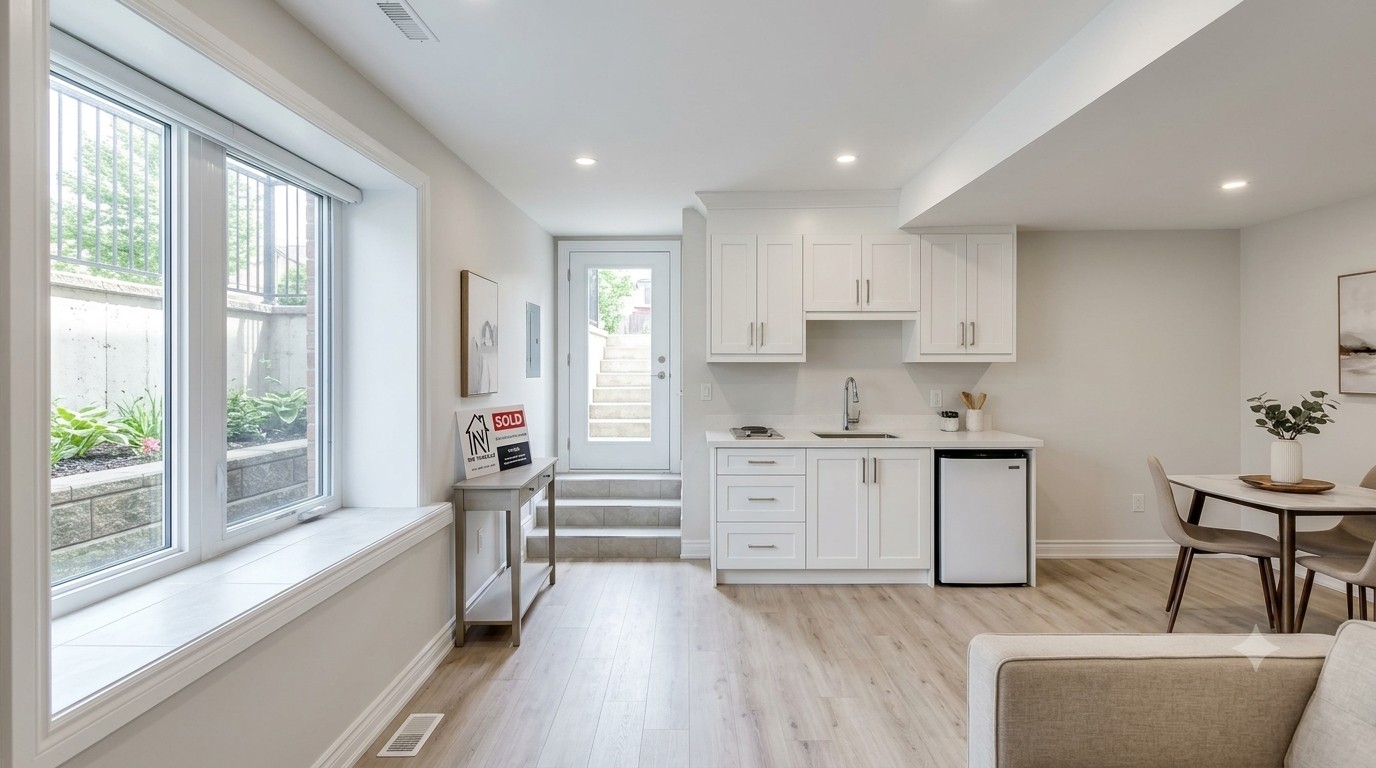
A home with a legal basement suite is one of the most financially powerful first purchases available in Ontario's current market — and it is also one of the most frequently misrepresented features in real estate listings. "Income suite," "in-law suite," "secondary dwelling," "basement apartment" — these phrases appear in hundreds of Ontario listings and carry wildly different implications depending on whether the unit is legal, illegal, unpermitted, or simply unfinished space with a fridge in it. The difference between a legal basement suite and an illegal one is not cosmetic. It is the difference between a rental income that your lender can use to qualify you for a larger mortgage, a tenant relationship that Ontario landlord-tenant law governs, and an insurance policy that covers a claim — versus an income stream that disappears the moment the municipality conducts an inspection or a tenant calls bylaw enforcement. This guide gives you the complete verification playbook, the Ontario building code requirements, a rent offset calculator, and the markets where the income suite thesis works best.

Looking for homes with verified legal income suites in Milton or surrounding markets? Reply to this email or book a free 15-minute call with Nik — we'll filter active listings by basement configuration and walk through the verification process for any property you're considering before you offer.

Step 1: Legal vs Illegal Basement Suite — Why the Distinction Matters More Than You Think

In Ontario, a basement apartment is either permitted and compliant with building code and zoning — in which case it is legal — or it is not, in which case it is illegal regardless of how nice the finishes are, how long the seller has been renting it, or what the listing calls it. There is no "mostly legal" or "legal except for one thing." Non-compliant basement units create four specific categories of risk that buyers need to understand before offering on any property with a secondary unit:

  1. Mortgage qualification risk. Lenders can only use rental income from a legal secondary suite to offset your qualifying income when calculating how much mortgage you can carry. An illegal suite's rental income is invisible to the lender — meaning the income that's supposed to make the purchase affordable doesn't help you qualify. Some buyers discover this after they've committed to a property and before financing is confirmed.
  2. Insurance risk. Most Ontario home insurance policies require disclosure of secondary suites. An undisclosed or illegal rental unit can void your policy coverage in the event of a claim — including a fire originating in the basement, which is the most common scenario. If you're insured for a single-family home and the insurer discovers you have an illegal basement tenant, your claim may be denied entirely.
  3. Municipal enforcement risk. Ontario municipalities increasingly enforce secondary suite regulations through proactive inspections and tenant complaints. A municipality order to vacate the illegal unit eliminates your rental income immediately, potentially while you're carrying the mortgage that was premised on that income being available.
  4. Tenant rights risk. Ontario's Residential Tenancies Act protects tenants in illegal suites as fully as it protects tenants in legal ones. A tenant in an illegal basement apartment cannot be evicted simply because the unit is non-compliant. If you purchase a property with an illegal suite and an existing tenant, you may be unable to remove that tenant without following the full RTA eviction process — which can take 6–18 months and is not guaranteed to succeed.

Step 2: How to Verify Whether a Basement Suite Is Legal — The Exact Process

Verification requires you to go to the source — the municipal building department — not to rely on the listing agent's representation or the seller's verbal confirmation. Here is the exact verification sequence:

  1. Search the municipal permit registry for the property address. Most Ontario municipalities now provide online permit search tools. Search the property address and look for a building permit specifically for a secondary dwelling unit, basement apartment, or accessory dwelling unit (ADU). A permit that was opened and closed (inspections passed) is the gold standard. A permit that was opened and never closed (never inspected to completion) is worse than no permit — it confirms the work was started and then abandoned before code compliance was confirmed.
  2. Call the municipal building department and ask directly. Online systems are sometimes incomplete for older permits. A phone call to the building department with the property address will confirm whether a secondary suite permit was issued, whether it passed all required inspections, and whether the property is currently registered as containing a secondary dwelling unit. In most Ontario municipalities, this is a routine inquiry that takes 5–10 minutes. Do this during the conditional period — not after you've removed conditions.
  3. Check the zoning certificate and property file for zoning compliance. Even a permitted basement apartment may not be legal if the zoning does not permit a second dwelling unit on the property. Ontario's Bill 23 (More Homes Built Faster Act) has made secondary suites as-of-right in most Ontario residential zones, but older properties in some municipalities may have pre-existing restrictions. The zoning confirmation is part of the municipal due diligence and should be verified alongside the permit search.
  4. Have a home inspector with secondary suite experience assess the physical compliance. Even with permits confirmed, a property may have been renovated after inspection or may have deferred maintenance that has moved it out of compliance. Have the inspector specifically evaluate: ceiling height, egress window size and operability, smoke and CO alarm placement, separate electrical panel or sub-panel for the suite, and fire separation between the suite and the main dwelling.

Step 3: Ontario Building Code Requirements — What Makes a Basement Suite Legal

The Ontario Building Code sets minimum requirements for residential secondary suites that every unit must meet to be considered legal. The following are the most commonly checked and most frequently failed criteria:

  1. Ceiling height: minimum 1.95 metres (6 feet 5 inches). This is the most common reason basement suites fail code in Ontario's older housing stock — pre-1980s homes were frequently built with basement ceiling heights of 7 feet or less, and ductwork, beams, and structural elements can reduce functional headroom below the minimum. Measure actual clearance, not listed floor-to-ceiling height. A suite with a 2.0 metre nominal height that has a beam at 1.85 metres is non-compliant at the beam.
  2. Egress window: minimum clear opening of 0.35 square metres, with minimum dimension of 380mm. Every bedroom in a secondary suite must have an egress window large enough for emergency exit by an adult. Basement windows in older homes are frequently too small. An egress window that doesn't meet minimum dimensions fails code and is also a genuine safety issue in the event of a fire. Replacement egress windows cost $800–$2,000 per window installed, which is worth knowing before you offer.
  3. Separate entrance. The suite must have an entrance that does not require passage through the main dwelling's living space. A suite that can only be accessed through the main kitchen or living room is not compliant. Exterior side entrance doors, walk-out configurations, and exterior stairwell entries all satisfy this requirement.
  4. Fire separation between units. The Building Code requires a fire separation of at least 30 minutes between the secondary suite and the main dwelling, achieved through fire-rated drywall on shared walls and ceilings. A basement suite finished without fire-rated drywall on the ceiling (which is the floor of the main dwelling) is not compliant regardless of how finished it otherwise appears.
  5. Interconnected smoke and CO alarms. Both the suite and the main dwelling must have interconnected smoke alarms and carbon monoxide detectors — meaning when one triggers, all units are alerted. This is an electrical requirement that must be inspected and confirmed, not just visually assessed.
  6. Separate bathroom and kitchen. The suite must have its own bathroom and kitchen facilities. A basement room with a bar fridge and a hot plate does not constitute a kitchen under the Building Code. Minimum kitchen requirements include a sink with running water, a cooking surface, and counter space — all with proper plumbing and ventilation.
  7. Minimum suite size: 145 square feet for a bachelor/studio, plus minimum bedroom sizes. A compliant bachelor suite must be at least 145 sqft of habitable space. Bedrooms must be at least 7 sqft of floor space per occupant with a minimum dimension of 2.1 metres. Extremely small basement conversions may fail on size alone.

Step 4: The Rent Offset Calculator — What a Legal Suite Actually Does to Your Carrying Cost

The financial case for a home with a legal basement suite is most powerfully made through the net carrying cost after rental offset. Here is the worked math for Milton — the market where the income suite purchase thesis is most compelling for first-time and move-up buyers.

ScenarioWithout SuiteWith Legal Suite
Purchase price (Milton detached)$950,000$1,020,000 (suite premium ~$70k)
Down payment (20%)$190,000$204,000
Monthly mortgage (5.5%, 25yr)~$4,700/mo~$5,000/mo
Basement suite rental income (Milton)$0$1,800 – $2,200/mo
Net monthly carrying cost~$4,700/mo~$2,800 – $3,200/mo
Annual net saving vs no-suite equivalent—$18,000 – $22,800/year

The suite-equipped Milton home costs $70,000 more to purchase but delivers $18,000–$22,800 per year in reduced net carrying cost. The $70,000 premium pays back in 3.1–3.9 years through the rental offset alone — after which every year of the suite's operation represents a direct financial advantage over the equivalent non-suite property. Over a 10-year hold, the suite buyer is ahead by $110,000–$158,000 in cumulative carrying cost savings net of the purchase premium, independent of any appreciation differential between the two properties. For the practical guide to converting a bungalow to a dual-income asset, the Milton bungalow conversion guide covers the renovation approach in detail.

Step 5: The Best Ontario Markets for Income Suite Purchases Right Now

  1. Milton — best suite-to-price ratio in the GTA commuter belt. Milton's newer builds (2005–2015) frequently have above-grade basements with 9-foot ceilings, large windows, and walkout configurations that reduce the cost and complexity of creating a legal suite dramatically. The rental market in Milton for a 2-bedroom legal basement unit runs $1,800–$2,200 per month — supported by GO train commuter demand, hospital workers, and the city's growing manufacturing and logistics employment base. Bill 23's as-of-right secondary suite permissions mean zoning approval is no longer a barrier in most Milton residential zones.
  2. Hamilton Mountain — highest yield per dollar invested. Hamilton Mountain's older bungalow stock (1960s–1980s) is the most frequently converted income suite inventory in the GTA commuter belt, because the bungalow form factor makes basement suite conversion relatively straightforward and the $600,000–$750,000 purchase price produces the most attractive yield-to-entry ratios. A fully legal Mountain basement suite rents for $1,400–$1,800 per month — lower than Milton's but proportionally higher relative to the purchase price. The yield math is most compelling in the Mountain for buyers with renovation tolerance.
  3. Kitchener-Waterloo — student and professional rental demand combined. KW's combination of University of Waterloo student demand and professional tech-sector rental demand creates the most diverse and resilient basement suite tenant market of any Ontario secondary city. A legal basement suite near the University of Waterloo rents for $1,600–$2,200 per month depending on bedroom count and condition. Downtown Kitchener suites attract professional tenants at $1,400–$1,900 per month. The ION LRT corridor adds a walkability premium that further supports suite rental rates.
  4. Brampton — highest suite density, competitive but liquid tenant market. Brampton has the highest proportion of homes with basement suites (legal and illegal) in the GTA — a product of large detached homes on generous lots purchased by multi-generational families. The legal suite market in Brampton rents for $1,500–$1,900 per month for a 2-bedroom unit. The challenge in Brampton is distinguishing legal from illegal suites — the prevalence of basement conversions in the market means many properties represent units at various stages of compliance, and verification is especially important here.
 Nik's Insider Tip 

The income suite purchase I consistently recommend in the Milton market is a 2008–2014 detached with a walkout basement in the Harrison or Scott neighbourhood — specifically properties where the walkout creates a ground-level entrance on the rear of the home rather than a traditional stairwell side entrance. Walkout basement suites in Milton almost always meet ceiling height requirements naturally (the grade difference gives you the headroom), almost always have adequate window egress on at least three walls, and allow for a tenant entrance that is genuinely private and separate from the main dwelling rather than the adjacent-door configuration that creates friction with tenants who feel like they're entering through the side of your house. The walkout configuration adds $30,000–$50,000 to the purchase price of an equivalent non-walkout property, and it saves $15,000–$25,000 in basement finishing costs because the egress, the entrance, and the natural light are already there. When I'm working with buyers who want a legal suite in Milton, the walkout is always the first filter I apply to the listing search.

Browse Milton Homes With Income Suites and Basement Apartments

Active Milton listings filtered for homes with basement or income suite potential — including separate entrance, finished basement, and walkout configurations.

 Browse Milton Income Suite Homes → 

Or book a free 15-minute call with Nik — we'll walk through the permit verification process for any specific property you're considering and tell you honestly whether the suite qualifies as legal before you offer.

...Read More
1
2
3
4
5
...
19
Footer Logo
Copyright 2026 All rights reserved. PropTx MLS® assumes no responsibility for the accuracy of any information shown. The information provided herein must only be used by consumers that have a bona fide interest in the purchase, sale or lease of real estate and may not be used for any commercial purpose or any other purpose.
  • SPECTRUM REALTY SERVICES INC., Brokerage | Real Estate Broker | 416-736-6500, 289-644-9988 |
  • Terms of Use
  • |
  • Privacy Policy
  • |
  • Register
  • |
  • Login

Real estate website design by

Digital Coffee