

<h1 style="font-family:'Playfair Display',serif; font-size:42px; color:#2A2F30; font-weight:700; margin-bottom:20px; line-height:1.3;">Ontario Land Transfer Tax: How to Calculate It, What...

The Guelph Real Estate Market 2026 has entered a era of "Calculated Stability." After years of erratic shifts, the market has settled into a balanced rhythm that rewards strategy over speculation. For those buying a home in Guelph, the current landscape offers a rare combination of increased inventory and predictable borrowing costs. For those selling your house in Guelph, success now hinges on precision pricing and "turn-key" appeal as buyers become more selective.
Guelph remains one of Ontario's most resilient markets, driven by its diverse economy, the influence of the University of Guelph, and its reputation as a "Green City." Whether you are eyeing a historic limestone home in Old University or a modern subdivision in the South End, this guide provides the data-driven insights and neighborhood-specific advice you need to navigate the 2026 landscape profitably.
As of February 2026, the Guelph average home price 2026 has stabilized at approximately $744,069. While this represents a modest year-over-year adjustment, it masks the strength of specific sectors. The detached market continues to lead with an average price of $858,000, while the condo and townhouse segments have become the primary entry point for first-time buyers, averaging $569,900 (Waller, 2026).
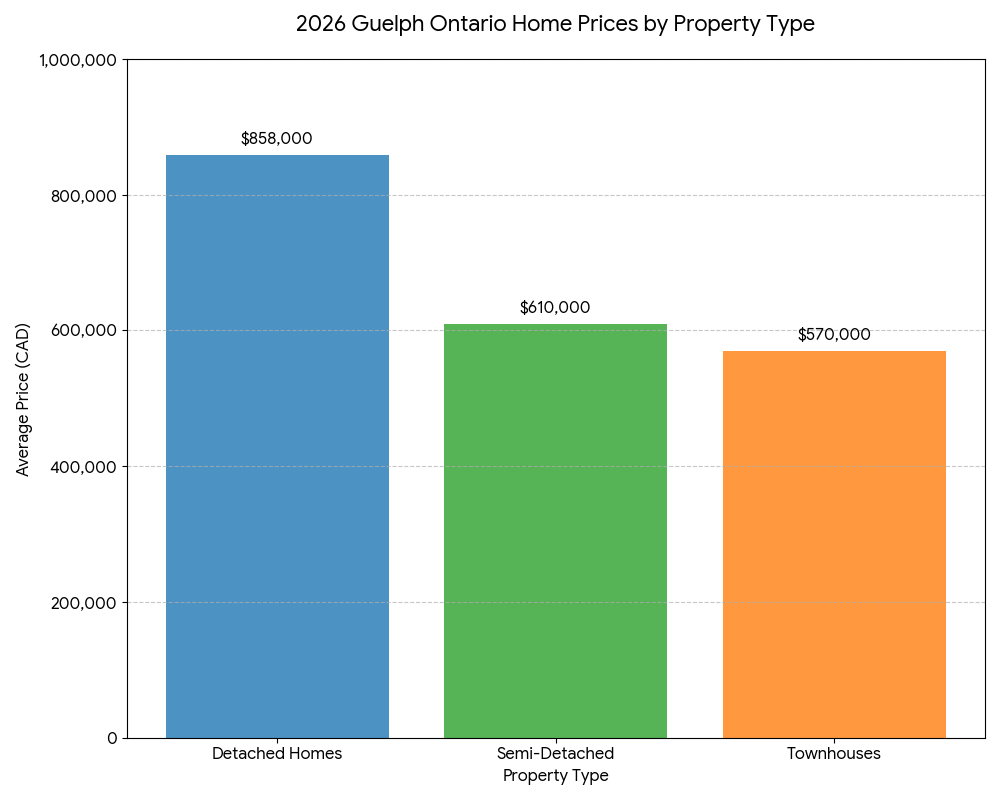
The defining characteristic of 2026 is the 4.1 months of inventory. This inventory level firmly places Guelph in a "Balanced Market." Unlike the scarcity-driven "bidding wars" of the past, buyers now have roughly 30 to 40 days to make decisions, leading to a much healthier environment for home inspections and financial due diligence. We are also seeing a "Quality Flight" trend where turn-key properties are selling at a 5-7% premium compared to homes requiring immediate renovation.
Unique Insight: A significant driver of 2026 inventory isn't panic selling, but rather "Mortgage Renewal Supply." With roughly 33% of Canadian mortgage holders facing renewals at higher rates this year, many homeowners are choosing to downsize or "right-size" proactively, injecting high-quality listings into the real estate inventory Ontario 2026 landscape (Nesto, 2026).
Each corner of the "Royal City" offers a distinct investment profile. Choosing the right neighborhood is the first step in maximizing your long-term ROI.
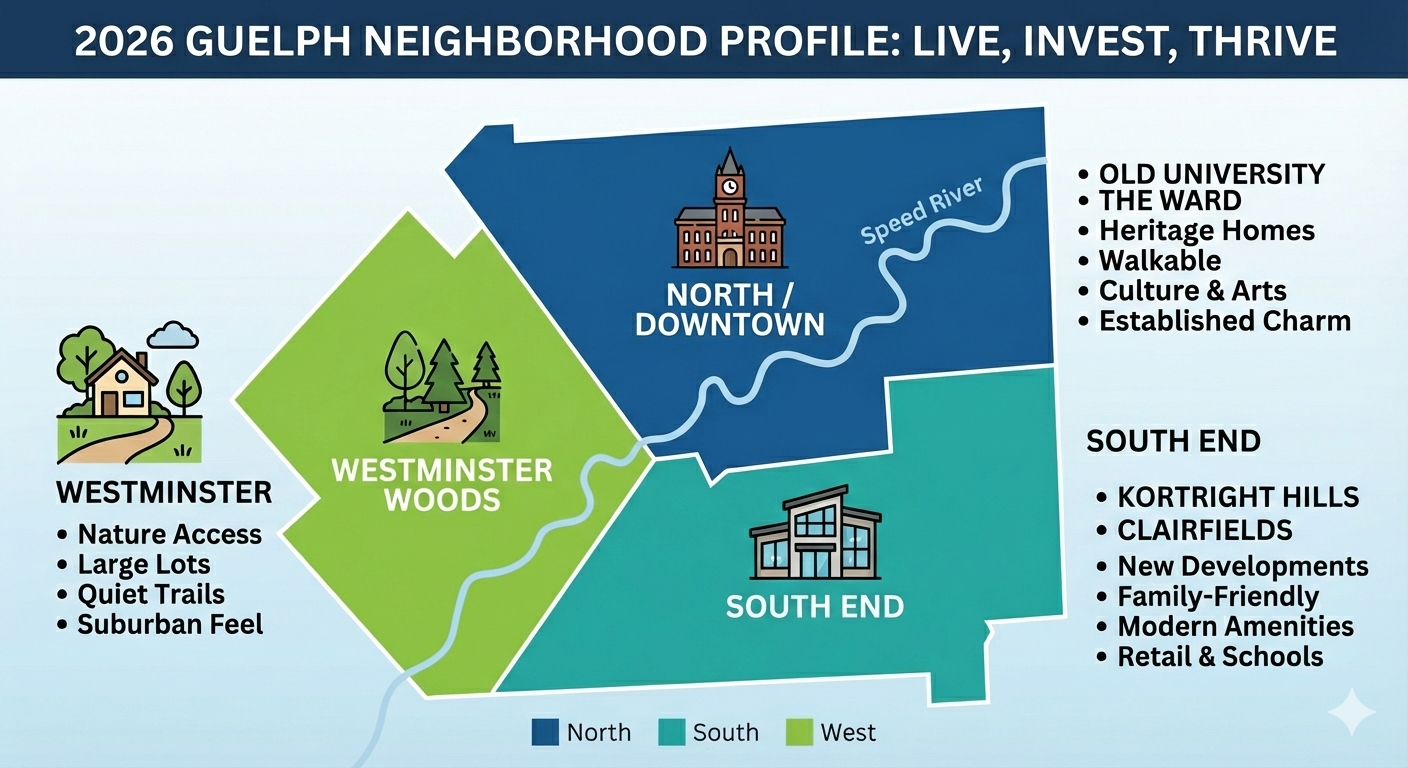
Known for its Old University heritage homes and tree-lined streets, this area remains Guelph's most stable asset. Its proximity to the university and downtown makes it a perennial favorite for professionals. Even in a flat market, these homes tend to hold their value due to their architectural uniqueness and central location.
If you are looking for Kortright Hills real estate, you are likely prioritizing space and nature. This southwestern pocket is famous for its mature forests and large lots. In 2026, it remains a top choice for move-up buyers who want a peaceful residential feel without the long Hespeler vs Guelph commute (Arnold, 2025).
The Ward is currently undergoing a massive cultural and residential evolution. Mixing historic character with modern infill developments, it attracts a younger demographic. It offers a more accessible entry price than the South End while providing significant long-term appreciation potential as the area gentrifies.
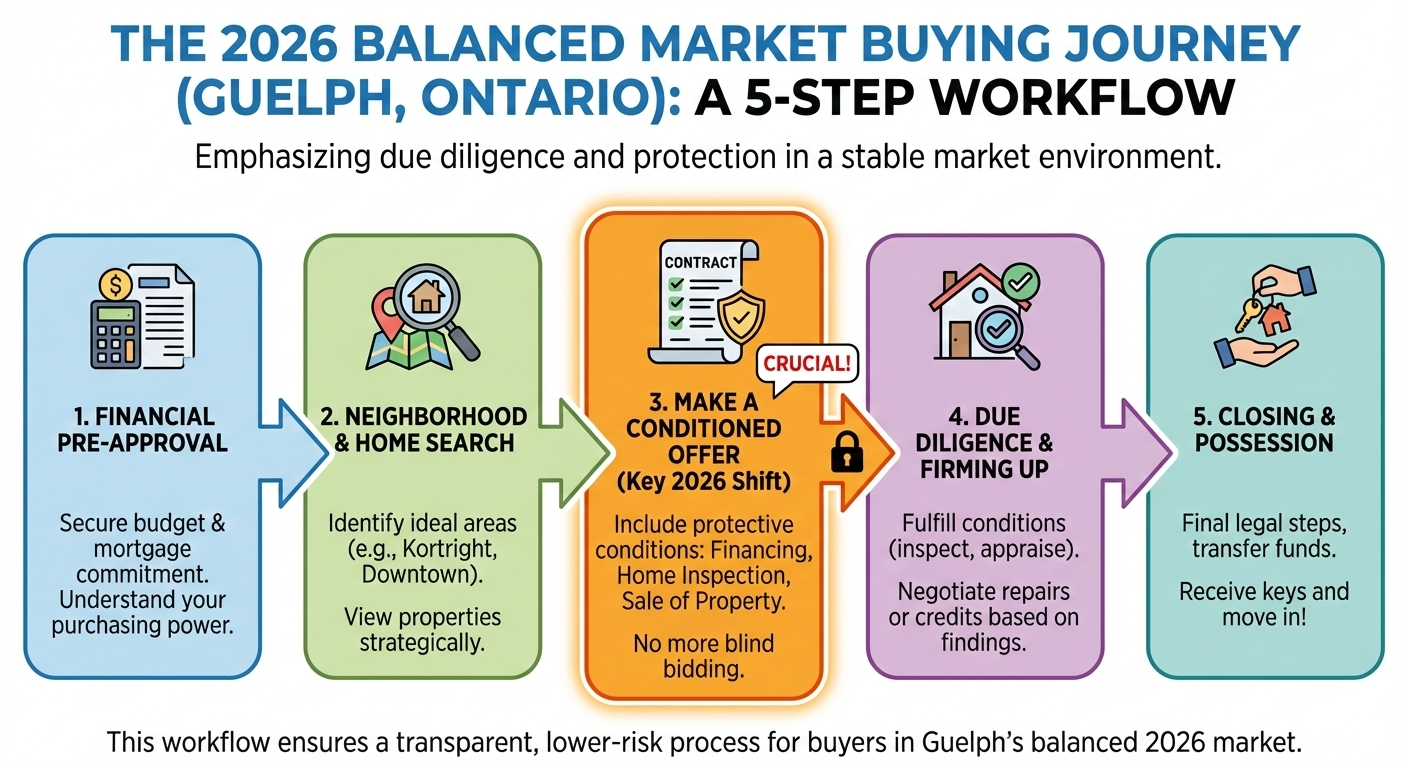
In a buyers market Guelph scenario, your greatest weapon is your ability to include conditions. In early 2026, nearly 80% of sales are closing with conditions for financing and home inspections—a massive shift from the "unconditional offer" era of 2022 (Waller, 2026).
Focus on **Energy-Efficiency**. With rising utility costs, an **energy-efficient home value** is higher than ever. Look for properties with upgraded heat pumps, triple-pane windows, or "Green" certifications. These homes not only save you money monthly but will have a significantly higher resale value in the 2030s. If a detached home is out of reach, consider the "Condo Ladder" strategy; Guelph's condo market is currently seeing a surplus, creating a perfect entry point for those looking to build equity before moving into a freehold property.
Success when selling your house in Guelph in 2026 requires a "Retail Mindset." Buyers are no longer willing to look past clutter or deferred maintenance. To hit the top of the price range, professional staging is non-negotiable.
Strategic Pricing: The most common mistake in 2026 is pricing based on "historical peaks" rather than current "sold data." A home priced 3% above market value will likely sit for 60+ days, leading to a "stale" listing. Instead, price at the "Fair Market Value" to generate immediate interest. High-end digital assets, including 4K drone footage and interactive 3D floor plans, are now the standard for attracting out-of-town buyers from the GTA who are looking for more value in the Guelph region.
Understanding the full cost of the transaction is vital for a stress-free move. With the Bank of Canada holding the overnight rate at 2.25%, 5-year fixed mortgage rates are currently ranging between 3.7% and 4.2% (True North, 2026).
The Guelph real estate market 2026 represents a rare "sweet spot" for participants. The frantic pace of previous years has been replaced by a market that values transparency, quality, and logic. For buyers, the current inventory provides the variety and time needed to find a home that truly fits your lifestyle goals. For sellers, the stability of the market offers a predictable exit strategy, provided you are willing to invest in the presentation and pricing accuracy of your property.
Guelph's long-term outlook remains incredibly strong. As a primary hub for education and tech-driven manufacturing, the demand for housing will continue to outpace provincial averages over the next decade. Whether you are making a move for family, work, or investment, Guelph remains one of the smartest places in Ontario to call home.
Are you ready to explore the Guelph market? Contact our local experts today for a personalized market valuation or a curated tour of the city's best "hidden gem" listings.
1. Is Guelph still more affordable than Toronto in 2026?
Yes. While prices have risen, Guelph offers a significantly lower cost per square foot than the GTA, making it a top choice for "commuter-friendly" lifestyle upgrades.
2. Should I include a home inspection in my Guelph offer?
In 2026, yes. With a balanced market, most sellers expect home inspection conditions. It is your best protection against hidden costs.
3. How much is the Land Transfer Tax in Guelph?
Ontario Land Transfer Tax is calculated on a sliding scale. For an average $750,000 home, the tax is roughly $11,475, though first-time buyers may be eligible for a rebate of up to $4,000.
4. What is the fastest-growing neighborhood in Guelph?
The South End (Clairfields) continues to see the most new construction, while The Ward is seeing the most significant "re-development" growth.
5. Are interest rates expected to drop further in 2026?
Current forecasts suggest the Bank of Canada will hold the policy rate at 2.25% for most of 2026, providing a stable environment for fixed-rate mortgages (Nesto, 2026).
Are you planning to buy or sell in Guelph this year? We want to know your biggest concern! Is it the interest rates, or finding the right neighborhood? Leave a comment below or share this article to help your friends navigate the 2026 market!





<h1 style="font-family:'Playfair Display',serif; font-size:42px; color:#2A2F30; font-weight:700; margin-bottom:20px; line-height:1.3;">Ontario Land Transfer Tax: How to Calculate It, What...
<h1 style="font-family:'Playfair Display',serif; font-size:42px; color:#2A2F30; font-weight:700; margin-bottom:20px; line-height:1.3;">Buying a Home With a Legal Basement Suite in Ontario...