
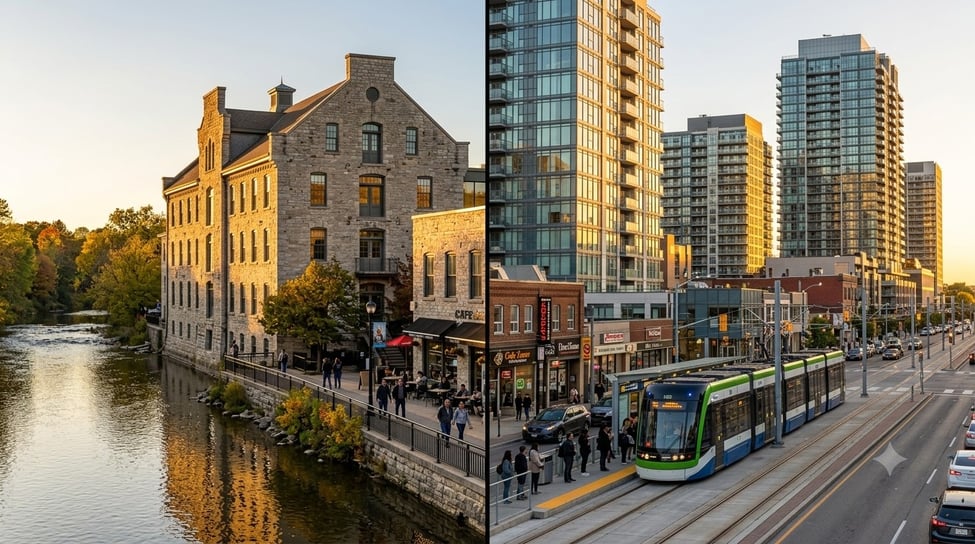
Guelph vs Kitchener Real Estate: Price-Per-Sqft, Commute, Schools, and Lifestyle — The Complete Data-Driven Comparison
Guelph and Kitchener-Waterloo are the two most frequently compared Ontario markets for buyers moving out of the GTA — close enough in price, proximity, and lifestyle appeal that the decision genuinely isn't obvious from research alone. The short version: Guelph is the better address if your commute runs west or your workplace is within the city itself, your priority is heritage character and green space access, or you're a family buyer prioritising school quality and established neighbourhood stability. Kitchener is the better address if your employer is in the tech corridor, you want ION LRT access, or your commute runs east toward Cambridge and the 401. This post maps every variable that actually separates the two markets — price-per-sqft, commute geometry, school systems, appreciation drivers, and lifestyle character — so the decision is made on data rather than marketing.
Still genuinely undecided between Guelph and Kitchener? Reply to this email or book a free 15-minute call with Nik — bring your workplace address, your pre-approval range, and your school timeline. We'll map the right market against your actual situation rather than generic city comparisons.
The Head-to-Head: Every Variable That Separates Guelph and Kitchener
The table below maps 12 decision variables across both markets using approximate current ranges. All figures represent directional benchmarks based on recent market conditions rather than audited transaction data — use them to orient the comparison, then verify specific neighbourhoods through the live listing tools linked at the end of this post.
| Variable | Guelph | Kitchener-Waterloo |
|---|---|---|
| Avg Detached Price | $750k – $1.0M | $730k – $1.05M |
| Est. Price/Sqft (detached) | ~$400–$470/sqft | ~$370–$440/sqft |
| Typical Lot Frontage | 35–55 ft (suburbs); 50–80 ft (established) | 35–50 ft (Doon South); 40–60 ft (Westmount) |
| GO Transit to Toronto | ~1h 45min via VIA Rail / GO Bus, limited frequency | ~2h via GO Bus (expansion pending), limited frequency |
| Drive to Mississauga | 45–60 min off-peak via 401 west | 55–70 min off-peak via 401 west |
| Drive to Cambridge | 20–28 min via 401 east | 10–18 min via Highway 8 |
| Local Transit (LRT) | Bus network only — no LRT | ION LRT (Stage 1 operational) — Conestoga to Fairway |
| Top Secondary Schools | John F. Ross CVI, Centennial CVI, Bishop Macdonell CSS | Resurrection CSS, Bluevale Collegiate, Grand River Collegiate |
| University Proximity | University of Guelph — 5 min from S. Guelph, within city | University of Waterloo + Wilfrid Laurier — 10 min from core KW |
| Tech Employment Base | U of G research spinouts, ag-tech, Linamar, local professional services | Google, OpenText, Shopify, Communitech ecosystem, BlackBerry security |
| Natural / Trail Access | Speed River, University Arboretum, Hanlon Creek, Kortright Conservation | Grand River Conservation trails, Victoria Park, Doon Valley |
| City Character | Heritage stone downtown, independent commercial culture, university-town feel | Tech-urban hybrid, Innovation District, multicultural, growing arts scene |
Price-Per-Square-Foot: Kitchener Offers More Space, Guelph Charges More Per Foot
The Pricing Paradox
Guelph and Kitchener have nearly identical average detached sale prices — both in the $750,000–$1,050,000 range. But Kitchener delivers approximately 8–12% more square footage per dollar. The reason: Guelph's character premium. Buyers pay for Guelph's Speed River heritage district, the University of Guelph's community anchor, and the city's distinctly independent commercial culture — none of which appear on a floor plan but all of which inflate price-per-sqft above what pure square footage analysis would justify. Kitchener's price-per-sqft discount is a real value, but it's not a free lunch — you're forgoing the Guelph character premium for it.
On a pure price-per-sqft basis, a buyer with an $850,000 budget gets approximately 1,950–2,100 sqft in Guelph's South or East postcode neighbourhoods, versus 2,100–2,350 sqft for an equivalent budget in Kitchener's Doon South or Huron Park. That 150–250 sqft gap represents roughly one additional bedroom or a meaningfully larger basement — a real difference for families with three or more children or anyone who works from home and needs a dedicated office rather than a kitchen-table setup.
The counter-argument for Guelph's higher price-per-sqft: appreciation history. Guelph has demonstrated more consistent price floor maintenance during the 2022–2024 correction than Kitchener-Waterloo, which experienced sharper percentage drops in the condo and townhome tier. The Guelph detached market's relative resilience during corrections is partly structural — the city has less speculative investor inventory than KW's tech-adjacent condo cluster — and partly demand-fundamental, because the University of Guelph's employment base provides a counter-cyclical demand floor that Kitchener's more volatile tech sector does not. Buyers prioritising capital preservation over maximum square footage lean toward Guelph on this basis. For the detailed KW investment analysis, the KW tech corridor analysis maps the ION LRT appreciation thesis and neighbourhood-by-neighbourhood data.
Commute Comparison: Which Market Wins for Your Specific Workplace
The commute question resolves the Guelph vs Kitchener decision for a significant proportion of buyers — not because one city is objectively better at commuting, but because each is better for specific corridor directions. Map your workplace against the geometry below before treating this as a lifestyle decision.
| Workplace | From Guelph | From Kitchener | Winner |
|---|---|---|---|
| Milton (401 west) | 30–40 min | 45–55 min | 🏆 Guelph |
| Mississauga corridor | 45–60 min | 55–70 min | 🏆 Guelph |
| Cambridge | 20–28 min | 10–18 min | 🏆 Kitchener |
| Waterloo tech corridor | 28–38 min | 8–18 min (by car or ION) | 🏆 Kitchener |
| University of Guelph | 5–15 min (S. Guelph walkable) | 28–40 min | 🏆 Guelph |
| University of Waterloo / WLU | 30–40 min | 10–20 min (ION accessible) | 🏆 Kitchener |
| Downtown Toronto | ~1h 45min GO / 90–100 min drive | ~2h GO Bus / 100–115 min drive | 🏆 Guelph (marginal) |
The commute table resolves cleanly for most buyers: if your workplace is in the 401 west corridor (Milton, Mississauga, Oakville, Burlington), choose Guelph. If your workplace is in the 401 east corridor (Cambridge, Kitchener, Waterloo, the tech campus cluster), choose Kitchener. The two cities are equidistant from Toronto in a way that gives neither a decisive advantage for that specific commute — but both are legitimate only for hybrid or remote-primary workers making that trip 2–3 days per week rather than daily.
School Systems: A Closer Look at What Each City Actually Offers
Both Guelph and Kitchener-Waterloo operate under well-resourced school boards — the Upper Grand District School Board and Wellington Catholic District School Board in Guelph; the Waterloo Region District School Board and Waterloo Catholic District School Board in KW. At the system level, both produce good educational outcomes. The differentiation matters at the specific school and programme level.
Guelph's school advantage is concentrated in specific high-performing elementary catchments — Kortright Hills PS, Westminster Woods PS, and several South Guelph elementaries where the University of Guelph faculty demographic creates parent engagement levels and resource mobilisation that exceed typical Ontario suburban averages. At the secondary level, Guelph's school profile is solid but not exceptional — John F. Ross CVI and Centennial CVI are comprehensive high schools without the specialized AP depth that drives school-based purchase decisions in Hamilton's Ancaster.
Kitchener-Waterloo's school advantage is concentrated at the secondary level — specifically in the dual-credit programs between WRDSB secondary schools and Conestoga College, and in the University of Waterloo partnership programming available to secondary students in the tech-adjacent schools near the Research and Technology Park corridor. The ION LRT's connection between residential areas and the university corridor also creates unique co-op and dual-credit access for secondary students that Guelph's bus-only transit cannot replicate at the same convenience level. For families whose priority is secondary school quality and post-secondary preparation, Kitchener-Waterloo's secondary ecosystem — particularly its Catholic secondary Bishop's Schools and the WRDSB's specialized programmes — is marginally stronger than Guelph's equivalent offering.
Lifestyle Character: The Intangible Difference That Actually Drives the Final Decision
After commute and price-per-sqft, most buyers who are genuinely undecided between Guelph and Kitchener make the final call based on city character — a combination of built environment, cultural offering, and the demographic they want to be surrounded by. This is the most personal variable in the comparison and the one least reducible to data, but it's worth mapping honestly.
Guelph is a university-and-heritage city with strong environmental values, a disproportionately independent commercial culture, and a civic identity that emphasises the arts, local food systems, and walkable neighbourhood life. The Guelph Farmer's Market, the River Run Centre for performing arts, the independent bookshops and farm-to-table restaurant culture of the downtown Stone Road and Gordon Street corridors — these reflect a community that has deliberately curated its character over decades. Guelph attracts buyers who want their city to have a soul that predates their arrival. The University of Guelph's presence anchors a professional-academic demographic that shapes everything from school PTSAs to the quality of independent businesses willing to take the risk of opening in a mid-size Ontario city.
Kitchener-Waterloo is a tech-and-manufacturing city in rapid cultural evolution. The Innovation District on King Street, the Communitech hub, the expanding restaurant and creative district in downtown Kitchener — all are evidence of a city that is becoming something rather than having already arrived. KW's character is more multicultural, more tech-forward, and more openly in transition than Guelph's. Buyers who find that energy exciting — who want to be in a city that's building its identity in real time alongside them — consistently prefer KW's character. Buyers who want to buy into an already-established community tend to prefer Guelph.
Neither character profile is objectively better. Both cities are good places to live. The question is which kind of city fits the life you're building — and that answer is personal enough that no data table resolves it. What does resolve it: spending one Saturday in each city, specifically in the neighbourhood you'd actually live in, and paying attention to how the environment feels rather than how the marketing describes it.
The Decision Framework: Which City Is Right for Your Profile
Choose Guelph if:
- Your workplace is at the University of Guelph, within Guelph city proper, or in the Milton/Mississauga/Burlington 401 west corridor
- You prioritise heritage character, independent commercial culture, and a city with an established identity
- Your children are elementary school age and you're targeting South or East Guelph's strong elementary catchments
- You want maximum green space and trail access woven into daily residential life (Speed River, Kortright Conservation, Hanlon Creek)
- You value capital preservation over maximum square footage and want a market with a demonstrated correction floor
- The GO train to Toronto is relevant — Guelph's 1h 45min VIA Rail is marginally faster than KW's GO Bus option
Choose Kitchener if:
- Your workplace is in the Waterloo tech corridor, at UW or WLU, in Cambridge, or anywhere in the 401 east employment cluster
- ION LRT access to your workplace or your children's school matters for your household's daily logistics
- Maximum square footage per dollar is your priority and you're comfortable accepting Guelph's character premium foregone
- Your children are secondary-school age and the dual-credit, co-op, and tech-pathway programming of WRDSB secondary schools is relevant
- You're drawn to a city in active evolution — the energy of a community building its identity in real time
- You're an investor targeting the ION LRT appreciation corridor — the Block Line to Fairway stretch represents the clearest remaining entry point before the transit premium fully prices in
The buyer I see most often genuinely stuck between Guelph and Kitchener is a dual-income professional couple where one partner works at the University of Guelph or in the Guelph professional services market, and the other works in Waterloo's tech corridor. For that household, neither city is perfectly located — one partner commutes 8 minutes and the other commutes 30. The tiebreaker for this specific profile is almost always school priority: if they have young children and the elementary school question is live, Guelph's South Guelph catchment wins. If the children are secondary-school age and tech-pathway programming matters, KW's secondary ecosystem wins. I've never seen a couple in this exact situation regret either decision when they made it for the right reason. I've seen couples regret it when they made it for square footage or neighbourhood aesthetics alone.
Browse Guelph and Kitchener Listings Side by Side
Compare active listings in both markets — filter by price, property type, and postcode to benchmark what your budget actually buys in each city.
Browse Guelph Listings → Browse Kitchener Listings →Or book a free 15-minute call with Nik — bring both your workplace addresses and we'll tell you which city wins for your specific commute pattern, school timeline, and price point.