
Why Ontario's Tech Professionals Are Quietly Repricing Kitchener-Waterloo — And What the Data Actually Shows
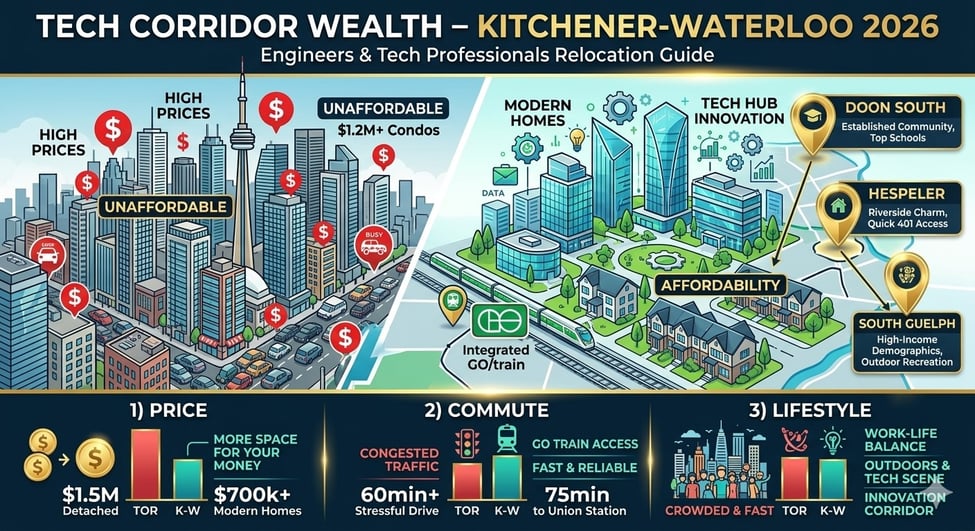
The migration of Ontario tech professionals from Toronto into Kitchener-Waterloo is not a trend story — it's a structural repricing event backed by measurable data. When the average software engineer in Waterloo Region earns within 15% of their Toronto counterpart but pays 45–55% less for equivalent housing, the financial case is not close. Add ION LRT infrastructure progressively pulling transit-accessible KW neighbourhoods toward GTA pricing benchmarks, and the window for entry at current pricing narrows every quarter. This post maps four specific data layers: the salary-to-housing cost ratio across markets, ION LRT appreciation by corridor, the Doon South vs Westmount neighbourhood trade-off, and the commute math that determines which KW addresses actually work as GTA commuter bases.
Running the numbers on a KW purchase as a tech professional? Reply to this email or book a free 15-minute call with Nik — we'll model the carrying cost comparison against your specific salary, savings, and work-from-home frequency before you commit to a direction.
The Salary-to-Housing Ratio: Why the KW Case Is Stronger Than It Looks
The standard objection to KW over Toronto goes: "But Toronto salaries are higher." That's accurate in absolute terms — the Toronto tech market commands a 10–20% salary premium across most engineering and product roles. What the objection misses is the ratio. The question isn't whether you earn more in Toronto. It's whether the additional income covers the additional housing cost. It does not — and the gap is significant enough to change the financial trajectory of a 10-year hold.
The following table uses approximate representative figures based on current Waterloo Region and GTA market conditions. Individual salaries and home prices vary by role, seniority, neighbourhood, and timing — use these as directional benchmarks, not precise predictions.
| Market | Avg. Software Engineer Salary | Avg. Detached Home Price | Price-to-Income Multiple | Est. Monthly PITH (20% down, 5.5%) |
|---|---|---|---|---|
| Kitchener-Waterloo | $92k – $125k | $730k – $870k | ~7.0x | ~$4,950 – $5,700/mo |
| Mississauga | $100k – $135k | $1.05M – $1.35M | ~10.0x | ~$6,900 – $8,500/mo |
| Toronto (GTA) | $110k – $148k | $1.3M – $1.7M | ~11.5x | ~$8,500 – $10,800/mo |
The monthly carrying cost difference between a KW purchase and a Toronto-equivalent is approximately $3,500–$5,000 per month — or $42,000–$60,000 per year in after-tax housing cost. A Toronto engineer earning $20,000 more annually than their KW counterpart is not closing that gap; they're absorbing it and working harder to stay in the same place financially. Over a 10-year hold, the KW buyer redirects that capital into savings, investments, or accelerated mortgage paydown — compounding a structural wealth advantage that the salary premium never comes close to neutralising.
The Compound Advantage
A KW tech buyer at $800k (20% down) vs a Toronto buyer at $1.5M (20% down) carries $700k less mortgage. At 5.5% over 25 years, that's a $4,300/month payment difference. Invested at a conservative 6% annual return instead, that $4,300/month compounding over 10 years generates approximately $700,000 in additional wealth — independent of any property appreciation. The KW property also appreciates. The math is not close.
ION LRT Appreciation by Station Corridor: Where the Infrastructure Premium Is Landing
The ION light rail transit system — running from Conestoga in Waterloo through Uptown Waterloo, Downtown Kitchener, and east to Fairway — has produced measurable appreciation differentials along its corridor since Stage 1 opened in 2019. The pattern follows a well-documented transit-infrastructure appreciation model: properties within 800 metres of stations appreciate faster in the years following opening than comparables without transit access, as buyers price in the commute optionality and walkability premium. In KW, that pattern has produced differentiated results across the corridor depending on starting price points and neighbourhood character.
The table below represents estimated appreciation premiums for properties within 800m of ION stations vs comparable non-ION properties in the same general area, based on observed market behaviour since the line opened. These are directional estimates, not audited transaction data — individual properties vary based on build vintage, lot size, and condition. For active listings filtered by ION-adjacent postcodes, browse Kitchener real estate directly.
| Station / Corridor | Postcode(s) | Est. ION Appreciation Premium (vs non-LRT comps) | Primary Demand Driver | Forward Outlook |
|---|---|---|---|---|
| University / Research Park (Waterloo) | N2L, N2J | +12–18% | UW rental demand, tech campus adjacency, walkability premium already priced in | Moderate — premium largely captured, stable demand floor |
| Uptown Waterloo (Willis Way / Bridgeport) | N2J, N2K | +8–14% | Walkable retail, mature neighbourhood character, professional buyer demographic | Stable — well-established premium with limited downside |
| Downtown Kitchener (King / Victoria / Frederick) | N2G, N2H | +10–16% | Innovation District, Google/Shopify office presence, condo redevelopment cycle | Strong — still appreciating as downtown revitalisation continues |
| Block Line / Fairway (East Kitchener) | N2C, N2B | +5–10% | Affordable entry with ION access, attracting cost-sensitive buyer migration from core | Highest forward upside — premium not yet fully priced, Stage 2 Cambridge extension tailwind |
| Stage 2 Cambridge Corridor (future) | N1R, N3C, N3H | Pre-appreciation window | Infrastructure announcement effect — buyers pricing in future connectivity | Speculative — highest risk, highest potential upside on confirmed completion |
The clearest forward opportunity in the ION corridor is the Block Line to Fairway stretch in east Kitchener — the last segment of the existing line that hasn't fully captured the transit-adjacency premium that the University and Downtown stations have already baked in. For buyers willing to accept slightly longer walks to the station (8–12 minutes rather than 5), the entry prices in the N2C/N2B postcodes represent the same infrastructure access at a 15–25% discount to the core corridor. The KW mortgage friction guide covers the specific financing conditions affecting Kitchener buyers right now.
Doon South vs Westmount: The Two Neighbourhoods Tech Buyers Compare Most
Tech professionals relocating to Kitchener-Waterloo, Ontario almost always narrow their neighbourhood search to two pockets: Doon South (N2P), for its newer build stock and 401 proximity, and Westmount (N2M), for its established character and closer-in positioning. They serve fundamentally different buyer profiles, and the decision between them maps almost perfectly onto remote vs in-office work frequency. Here's the side-by-side analysis.
| Category | Doon South (N2P) | Westmount (N2M) |
|---|---|---|
| Price Range (detached) | $760k – $1.05M | $650k – $900k |
| Build Vintage | 2005–2018 (newer builds, modern layouts, open-concept) | 1950s–1980s (mature stock, entering major systems cycle) |
| ION LRT Access | No direct access — car-dependent for LRT | Within 10–20 min of core Kitchener stations — car or cycling viable |
| Hwy 401 Access | Excellent — 3–5 min to 401 via Homer Watson Blvd | Moderate — 10–15 min to 401 via King St or Ottawa St |
| Grand River / Trail Access | Excellent — Conservation Authority trails and Grand River directly accessible | Good — Victoria Park proximity; river trails reachable by bike |
| Walkability | Low — suburban street design, retail requires driving | Moderate-High — walkable cafés, retail, Victoria Park within reach |
| School Catchment | Doon PS (WRDSB), Resurrection CSS (WCDSB) — modern, well-resourced | Established WRDSB schools — strong community engagement, older facilities |
| Best Fit For | GTA commuters (3–5 days/week driving), families prioritising newer builds and trail access | Remote-first tech workers, lifestyle buyers who value walkability and neighbourhood character |
| Appreciation Driver | Newer build premium + 401 commuter demand + family formation cycle | ION corridor proximity + gentrification of inner Kitchener + reno uplift potential |
The decision framework is simpler than most buyers expect: if you are commuting by car to the 401 corridor 3+ days per week, Doon South is the correct choice — the highway access difference alone saves 10–15 minutes each way, compounding into roughly 80 hours per year. If you are working remotely or commuting to downtown Kitchener or Waterloo by transit or bicycle, Westmount offers better lifestyle infrastructure and ION access at a $100k–$150k lower entry point with meaningful renovation upside on the older stock.
Commute Math: KW to Toronto and Mississauga — What the Routes Actually Look Like
The commute from Kitchener-Waterloo to Toronto is the single most misunderstood variable in the KW relocation decision. Most buyers approaching from a Toronto-centric perspective assume the commute is prohibitive. The reality depends almost entirely on which Toronto employment node you're commuting to — and Mississauga changes the equation fundamentally.
KW to Mississauga Corporate Corridor (Hurontario, Erin Mills, Airport Road)
This is the commute that makes KW work for a much larger group of tech professionals than the Toronto narrative suggests. Major employers in Mississauga's corporate corridor — including Google (600 Boulevard Dr), Huawei Canada, LG Electronics, Honeywell, and the Erin Mills Parkway tech park cluster — are reachable from Doon South via Highway 401 East in approximately 45–60 minutes off-peak. Peak-hour additions of 20–35 minutes apply during morning and evening rush. For professionals on a 3-day in-office schedule, this is a meaningful but manageable commute — approximately the same drive time as inner-ring Toronto suburbs like Brampton or Mississauga's own western reaches commuting to the same employment nodes.
KW to Downtown Toronto (King West, Bay Street, Union Station Area)
By car, Kitchener to downtown Toronto via 401 East runs approximately 1hr 10min to 1hr 25min off-peak, extending to 1hr 45min–2hr 20min during peak hours. This is a legitimate 2–3 day per week commute for professionals with schedule flexibility; it is not a sustainable daily commute. Via VIA Rail from Kitchener GO Station, the train reaches Union Station in approximately 1hr 53min to 2hr 15min depending on service — with limited departures (typically 2–4 express trains per day). For remote-first professionals making occasional in-person trips to Toronto, VIA Rail represents a viable and comfortable option; for daily commuters, the car or GO bus is the more practical vehicle. The critical nuance: professionals whose Toronto offices are in or near Union Station fare better than those in the Financial District's eastern reaches, where the last-mile from Union adds another 15–25 minutes.
KW to Kitchener-Waterloo Tech Employers (Zero Commute Case)
The most underweighted variable in the KW analysis is the region's own employment depth. Google's engineering offices, Shopify's distributed team infrastructure, OpenText (headquartered in Waterloo), Blackberry's security division, the Communitech accelerator network, and a pipeline of Velocity Fund and UW spinouts mean that a meaningful and growing proportion of KW tech professionals are not commuting out of the region at all. For this cohort, the commute conversation is irrelevant — and the housing cost advantage is absolute rather than partially offset by travel time. Browse Kitchener homes to see current active listings in ION-adjacent and 401-adjacent postcodes.
The KW purchase I consistently recommend to tech professionals doing 2–3 days per week in Mississauga or Toronto is a detached home in the Doon South / Pioneer Park boundary — specifically on streets south of Bleams Road with direct Homer Watson access and Grand River trail proximity. You're 4 minutes to the 401, you have newer build quality from the 2010–2016 window (before lumber cost inflation), and you're buying a property that appeals to two distinct exit buyer profiles: GTA commuters who'll follow you there as the migration pattern continues, and KW-based tech families who want trail access. That dual exit market matters more than most buyers realise when you're thinking about a 7-year hold. The mistake I see is buyers overweighting walkability scores from Toronto's context — KW walkability means something different, and penalising Doon South for it is using the wrong benchmark.
Browse Kitchener-Waterloo Homes — Doon South, Westmount & ION Corridor
Active listings across KW filtered by postcode — N2P for Doon South, N2M for Westmount, N2G/N2H for the downtown ION corridor, and N2L for University area.
Browse Kitchener Homes Now →Doon South (N2P) Listings Only → | Westmount (N2M) Listings Only →
Or book a 15-minute call with Nik to map a specific neighbourhood against your commute pattern, salary, and 7-year hold thesis.