
Buying or Selling in Ontario’s 2026 Economic Uncertainty
The Year of Realism: Navigating the Shift in Power Dynamics
The Year of Realism: Navigating Ontario Real Estate in 2026
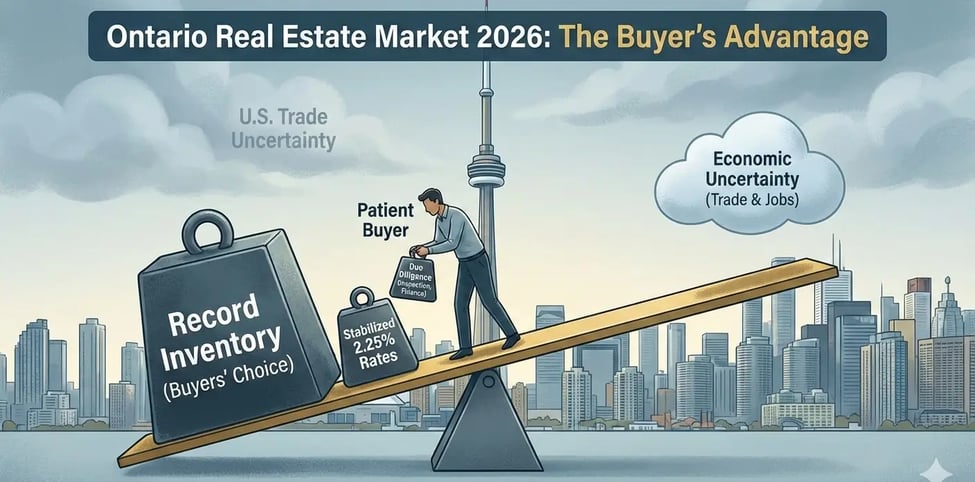
The "holding pattern" that characterized much of 2025 has finally broken, but not in the way many expected. As we move into the Ontario real estate market 2026, the frenzy of the past has been replaced by a "Year of Realism." With the Bank of Canada holding interest rates at a stabilized 2.25% and inventory levels in Ontario reaching decade highs, the power dynamic has shifted significantly.
Whether you are buying a home in Ontario or looking at selling a house in Ontario, the landscape is defined by caution. Trade jitters and a cooling labor market have kept some on the sidelines, yet pent-up demand—particularly among first-time buyers—is creating a floor for the market. This guide provides a deep dive into the Toronto housing market forecast, the regional divide across the province, and the financial strategies required to win.
The 2026 Ontario Economic Landscape: Stability Amidst Jitters
The current state of the Ontario real estate market 2026 is inextricably linked to the Bank of Canada’s recent pivot. After a series of cuts in late 2025, the overnight rate has settled at 2.25%. While this has brought much-needed relief to variable-rate holders and those facing mortgage renewals in 2026, the "wealth effect" has been dampened by external economic pressures.
The Inventory Surge and "Price Spillage"
According to recent data from the Canadian Real Estate Association (CREA), Ontario is currently experiencing a massive influx of listings. In many southern Ontario markets, inventory is at its highest level in eight years. This surplus has led to what economists call "price spillage"—a gradual softening of values, particularly in the Toronto housing market. While the national average price is expected to rise by 2.8%, Ontario is likely to see flatter growth or even modest declines of 1–3% in the first half of 2026.
The Trade War Factor
A unique insight for 2026 is the "Trade War Discount." Uncertainty regarding U.S. tariffs has caused a temporary "slumber" in high-end luxury markets and investor-heavy condo segments. Buyers are no longer just looking at interest rates; they are looking at job security and the macro-stability of the Canadian dollar.
Buying a Home in Ontario: Strategic Windows and Hidden Pockets
If you are buying a home in Ontario this year, you are entering the most favorable buyer’s market since 2018. However, it means you have the luxury of time and the power of conditions.
The Condo Correction Opportunity
The Toronto housing market forecast for 2026 highlights a significant correction in the condo sector. Condo prices in the GTA are projected to drop by as much as 6.5%. For first-time buyers or "right-sizers," this represents a generational entry point.
Expert Tip: Scrutinize the Status Certificate
Don't just look at the purchase price. In 2026, savvy buyers are scrutinizing "Status Certificates" more than ever. With rising insurance and maintenance costs, a "cheap" condo in an older building can quickly become a financial burden.
Negotiating with Confidence
In an uncertain economy, your strongest weapon is the Home Inspection Condition. The days of "no-condition" offers are largely gone. Use the high inventory levels to negotiate repairs and closing credits. Sellers with homes sitting for 60+ days are increasingly willing to pay for a buyer’s mortgage rate buy-down.
Selling a House in Ontario: Mastering the High-Inventory Market
For those selling a house in Ontario, the strategy has shifted from "marketing a dream" to "pricing a reality." With over 30% of current listings being "stale" carry-overs from 2025, standing out requires a surgical approach to valuation.
The "First 21 Days" Rule
In 2026, the market is ruthless toward overpricing. Data shows that properties that do not receive an offer within the first three weeks eventually sell for 5-8% less than original asking. Selling a house in Ontario now requires looking at "Sold" data from the last 30 days.
The "Move-Up" Buyer Advantage
If you are selling a smaller home to buy a larger one, the "gap" has narrowed. A 5% drop in your $800,000 sale is $40,000, but a 5% drop in your $1.5M purchase is $75,000. In an uncertain market, the "move-up" play is often the most profitable move.
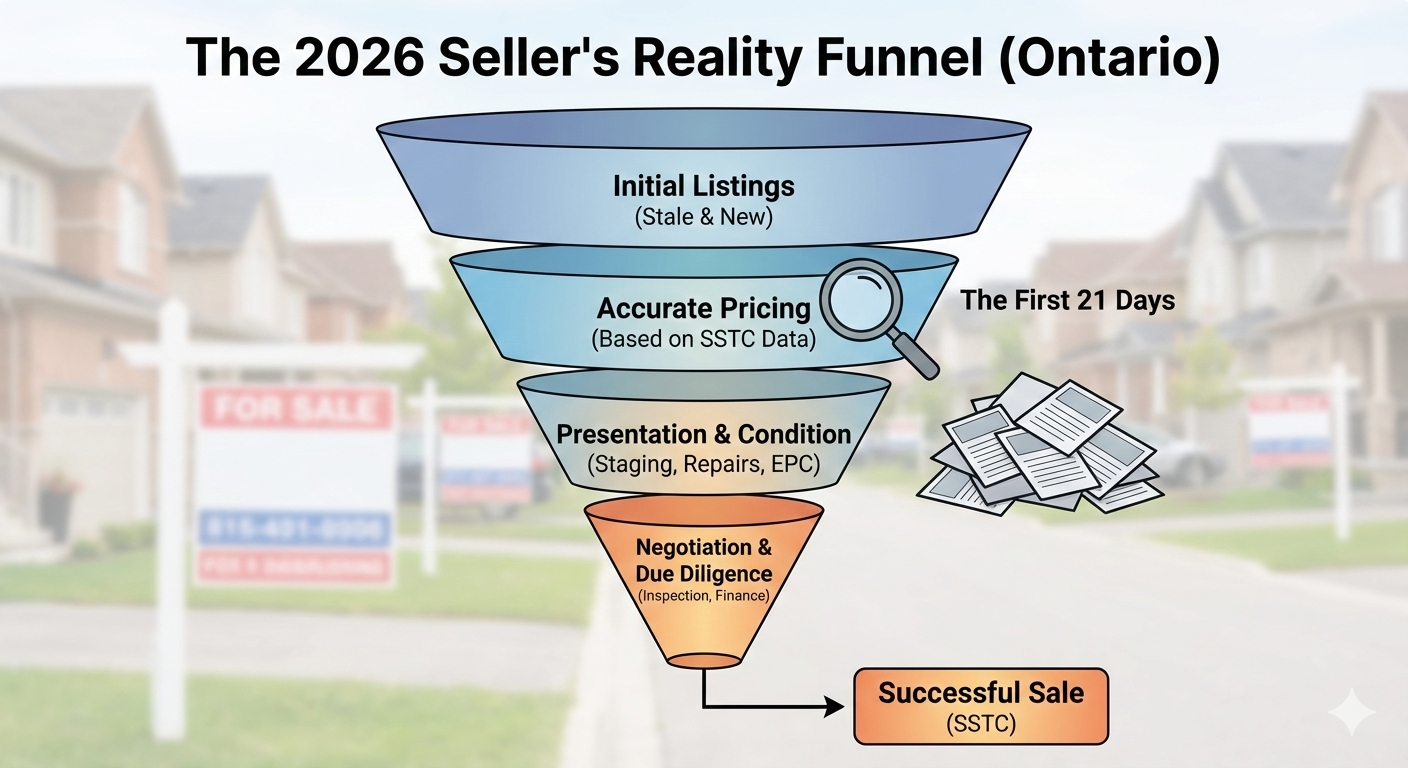
Ontario 2026 home selling funnel: illustrating the importance of accurate pricing and presentation in a high-inventory market.
Regional Deep Dive: GTA vs. The Rest of Ontario
The Ontario real estate market 2026 is a tale of two provinces. While Toronto struggles with inventory, other regions show resilience.
| Region | 2026 Outlook | Key Trend |
|---|---|---|
| Greater Toronto Area (GTA) | Cautious / Soft | Condo prices lead the decline; detached stable. |
| Ottawa | Balanced | Government stability keeps the market steady. |
| Kitchener-Waterloo | Moderate Growth | Tech sector rebound driving mid-market demand. |
| Northern Ontario | Strong | Affordability remains the primary draw. |
The "Doubling Up" Trend
A unique insight is the rise of the multigenerational household. Cities like Brampton and Mississauga have seen a 30% increase in "doubling up." Sellers with "legal basement apartments" are seeing a 15% premium.
Quick Takeaways: Your 2026 Ontario Action Plan
- Buyers: Focus on the condo sector for value; always include inspection conditions.
- Sellers: Price slightly below recent comparables to trigger immediate interest.
- Rates: Bank of Canada stabilized at 2.25%; don't wait for lower rates.
- Location: Look to secondary cities like London or Guelph for better price-to-rent ratios.
Conclusion
The Ontario real estate market 2026 is a market of calculation. Uncertainty has created a cooling period that benefits disciplined participants. As we look toward the latter half of 2026, the market is expected to wake as trade certainties return. The best moves are made with a 5-to-10-year horizon in mind.
FAQs
1. Is the Toronto condo market crashing in 2026?
We are seeing a significant price correction (projected ~6.5%), creating a buyer's market in that sector.
2. Should I choose a fixed or variable mortgage?
Many are opting for 3-year fixed rates for certainty while rates sit at 2.25%.
3. Is now a good time to sell an investment property?
It's challenging for high-maintenance condos, but detached homes with rental suites remain in high demand.
4. How are U.S. tariffs affecting prices?
The impact is psychological, causing a temporary slump in activity as buyers wait for economic clarity.
We Want to Hear Your Story!
Are you currently hunting for a home or trying to navigate a sale? Drop a comment below and share your experiences!
References
- CREA: 2026 Resale Housing Market Forecast
- RBC Economics: Canadian Housing Market Outlook 2026
- Royal LePage: 2026 Market Survey - Ontario Focus
- Bank of Canada: Monetary Policy Report - January 2026
Ready to see what’s available?
Strategize your next move with local data and 24/7 expert support.