

The Ultimate Milton Real Estate Guide: 2026 Edition
From Hawthorne Village to the Education Village — Navigating Canada's Fastest Growing Hub
For nearly two decades, Milton has held the title of one of Canada's fastest-growing municipalities, and as we move into 2026, the momentum shows no signs of slowing. Once a quiet stop at the base of the Niagara Escarpment, Milton has transformed into a sophisticated, multi-cultural urban hub that offers a rare balance: the high-octane economic energy of the Greater Toronto Area (GTA) paired with the serene, protected greenspaces of the Halton Region.
Whether you are a young professional seeking a modern condo near the GO station, a family looking for a master-planned community in Hawthorne Village, or an investor eyeing the massive potential of the new university district, Milton real estate offers a unique value proposition. This comprehensive guide will walk you through everything you need to know about buying a home here, from neighborhood deep-dives and school rankings to the 2026 market forecast.
1. Why Milton Real Estate is the Strategic Choice for 2026
Choosing a home in Milton is more than a lifestyle upgrade; it is a calculated financial move. While other parts of the GTA have struggled with inventory stagnation, Milton has proactively expanded. The town's "Big Pipe" project and aggressive infrastructure development have allowed for a consistent stream of new housing starts, keeping the market liquid and attractive for Halton Region properties.
The Death of the "Bedroom Community"
In 2026, the label is officially dead. With the opening of the Wilfrid Laurier University and Conestoga College campuses, Milton is transitioning into a vibrant university town. This shift is fundamentally changing the demographics, bringing in a younger, highly educated population and creating a robust rental market for investors. Buying here now means getting in on the ground floor of a major institutional expansion.
2. Deep Dive into Milton’s Most Popular Neighborhoods
When searching for Milton homes for sale, you quickly realize that the town is a collection of distinct "villages," each with its own architectural style and demographic profile.
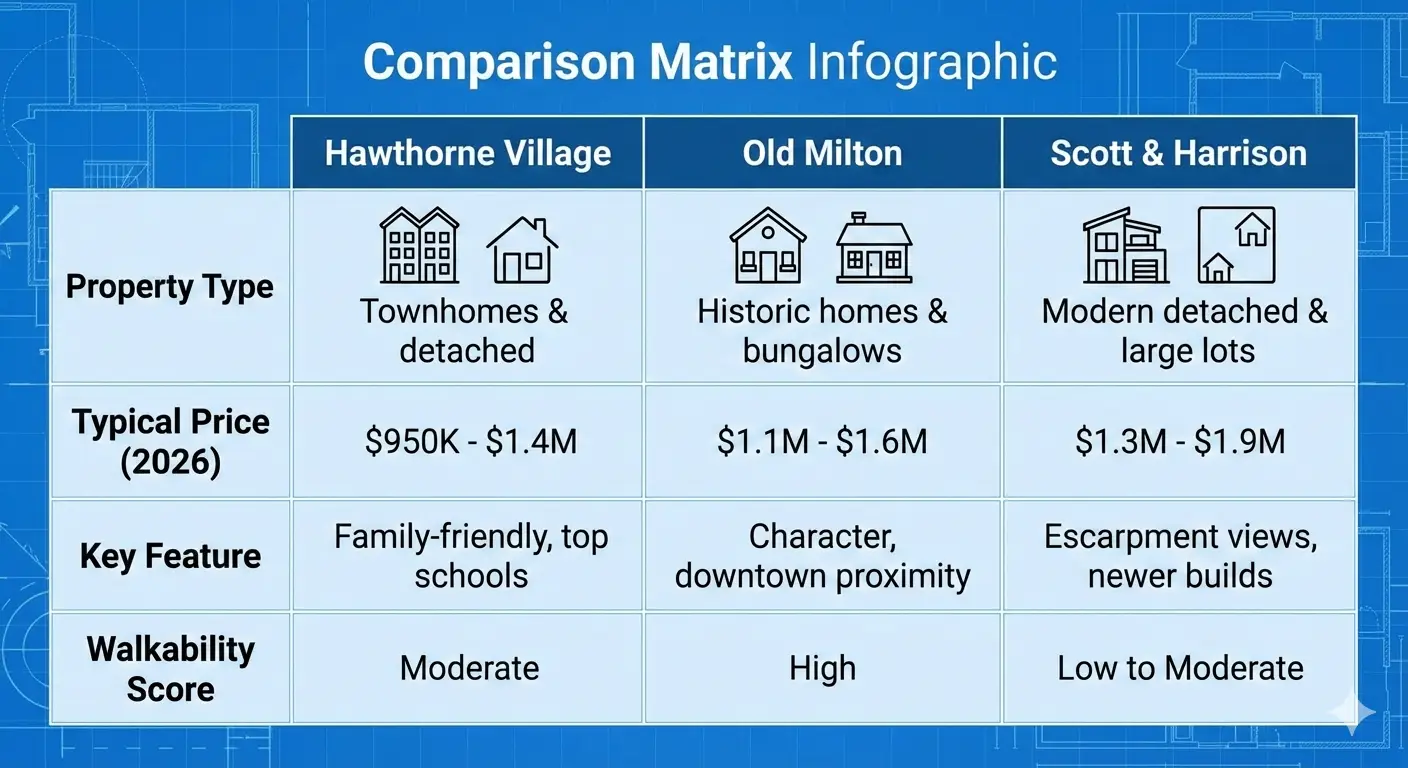
Hawthorne Village: The Family Favorite
Hawthorne Village remains the gold standard for master-planned living in Ontario. Developed largely by Mattamy Homes, this area was designed around the concept of "new urbanism," featuring front porches close to the street to encourage neighborly interaction. It is the most searched area for families due to its high density of parks and top-tier elementary schools.
Old Milton: Historic Roots and Walkability
For those who find suburban sprawl unappealing, Old Milton offers character homes, century-old trees, and immediate access to the downtown "Main Street" core. Here, you can find unique Victorian builds and 1950s bungalows on massive lots—a rarity in the newer developments.
Scott & Harrison: Escarpment Views and Modern Living
Located in the western part of the town, these neighborhoods are prized for their proximity to the Niagara Escarpment. Homes here often carry an "Escarpment Premium" because of the stunning views and immediate access to hiking trails. The housing stock is predominantly detached, 4-bedroom homes built within the last 15 years.
3. Education Excellence: Schools in the Halton Region
Schools like Bishop Reding Catholic Secondary and Irma Coulson Public School are frequently cited in the Fraser Institute's top rankings. In 2026, the focus has shifted toward STEAM (Science, Technology, Engineering, Arts, and Mathematics) programs, mirroring the town's goal to become a tech and innovation hub. Always verify catchment areas as they can shift due to rapid growth.
4. The Milton Education Village: A Game-Changer
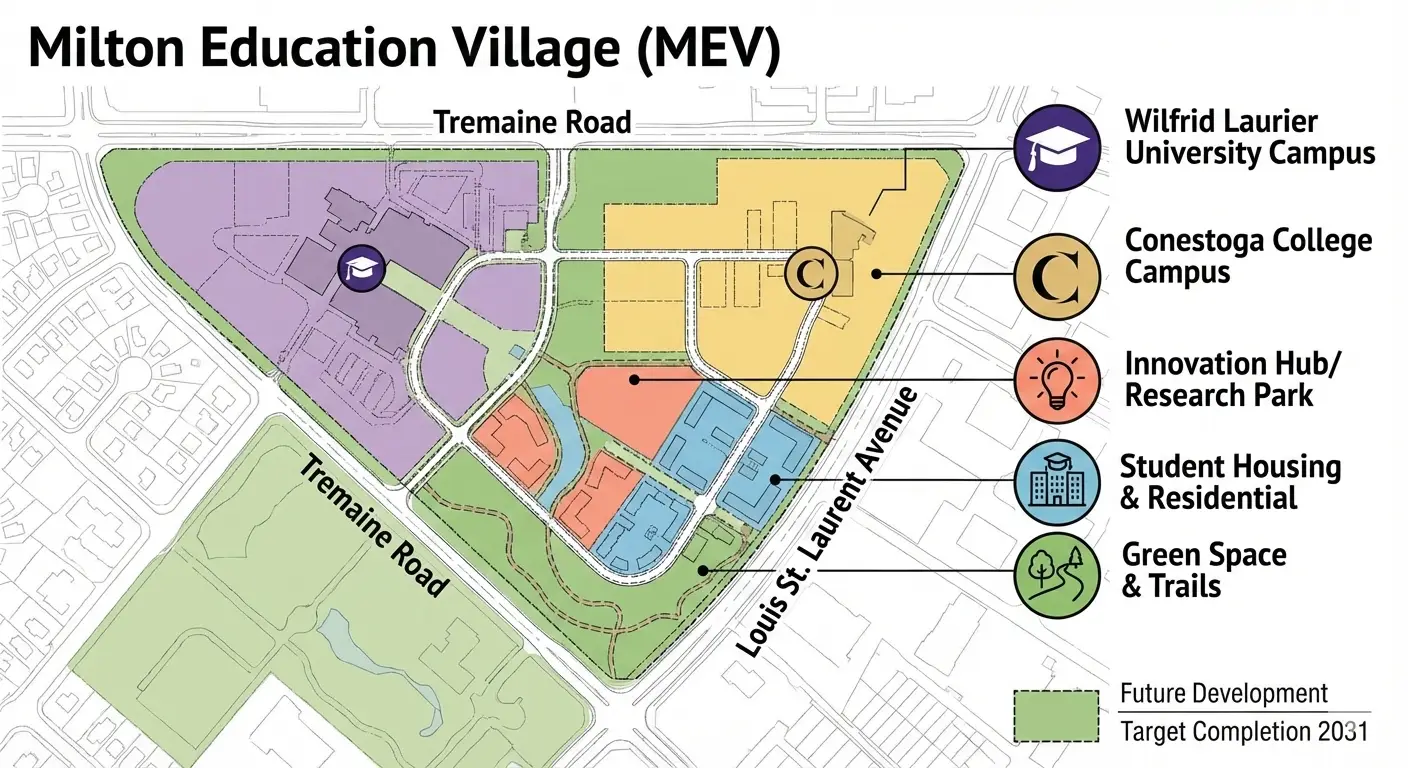
The Milton Education Village (MEV) is a 400-acre master-planned district located at Tremaine Road and Louis St. Laurent Avenue. By 2031, this area will house 15,000 students.
Investor Logic: The "Sure Bet"
The demand for student housing and faculty residences in this pocket is projected to outpace supply. We are seeing a surge in Milton condos and townhome developments specifically designed to cater to this new academic demographic.
5. Commuting and Connectivity
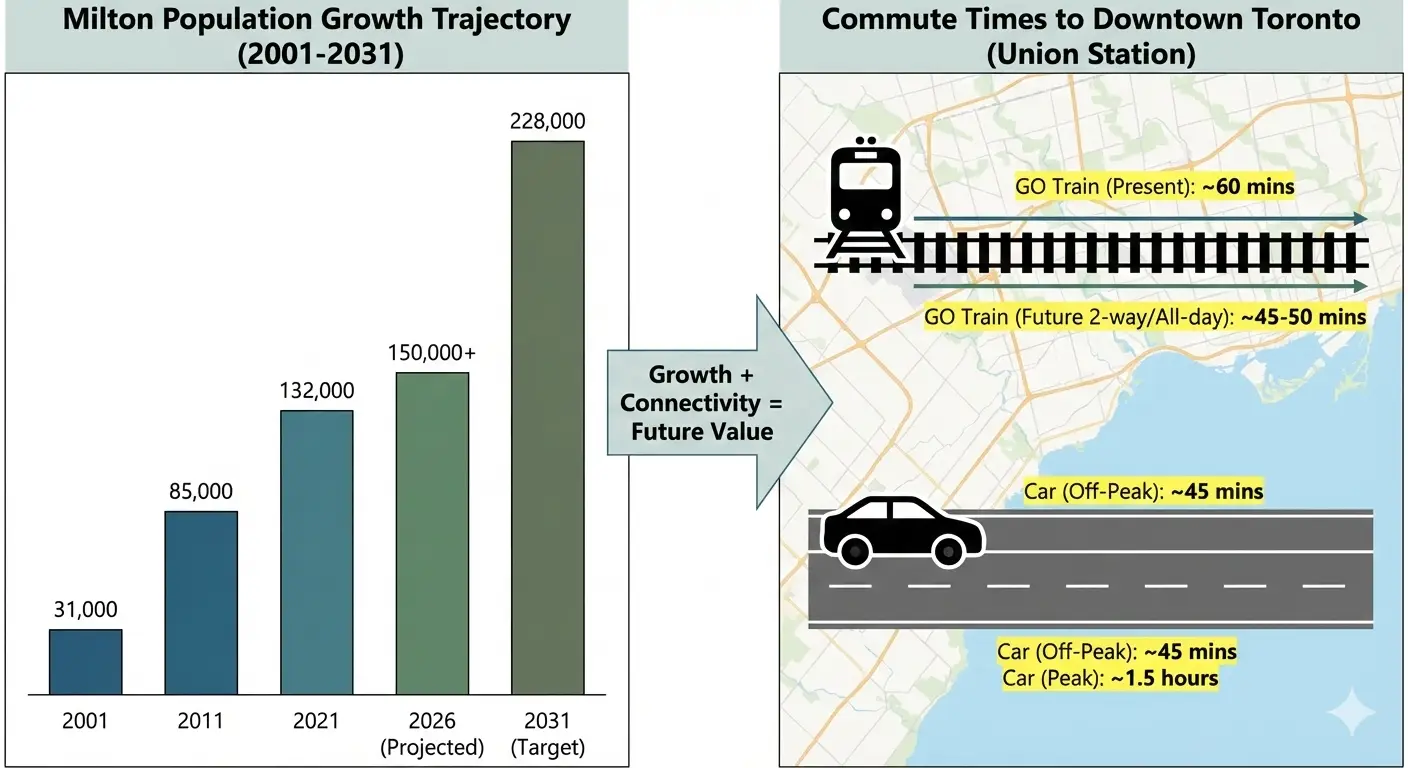
While Milton is famously situated along the Highway 401 corridor, its connectivity is evolving. The Milton GO Station expansion aims at two-way, all-day service by late 2026.
6. The "Active Lifestyle" Factor
Milton is home to the Mattamy National Cycling Centre and is surrounded by five major conservation areas (Kelso, Crawford Lake, Mount Nemo). This "green belt" ensures that the semi-rural feel is preserved even as the town grows.
7. Analyzing the Numbers: Milton Market Trends
| Market Metric (Q1 2026) | Current Value | Strategic Insight |
|---|---|---|
| Avg. Detached Price | $1.3M | Stabilized following 2024/25 fluctuations. |
| Inventory Levels | +15% increase | More "Due Diligence" time for buyers. |
| Avg. Days on Market | 22 Days | A healthy, "Rational" market speed. |
8. First-Time Home Buyer Perks
Milton remains more accessible than Oakville. Look for "coach houses" or homes with legal basement apartments. Milton’s zoning laws have become more favorable toward secondary suites, allowing buyers to use potential rental income to qualify for larger mortgages.
9. Future Outlook: Growth to 2031
Targeting a population of 228,000 by 2031. Infrastructure like the Britannia Road expansion is just the beginning. Investing now is buying into a city that hasn't reached its full potential yet.
Quick Takeaways for Buyers
- The University Effect: West end values are poised for long-term growth.
- Neighborhood Nuance: Hawthorne for families; Scott/Harrison for nature/views.
- Active Living: High resale value supported by 5 conservation areas.
- Investment Strategy: Condos and secondary suites are the 2026 top performers.
Conclusion: Is Milton Your Next Home?
The story of Milton is one of purposeful growth. In 2026, the market offers a rare "window of sanity" where inventory is sufficient for buyers to be choosy, but growth indicators remain positive. The time to explore is now, before the full impact of the university population hits in late 2026.
Frequently Asked Questions (FAQs)
1. Is Milton a good place for first-time home buyers in 2026?
Yes. While prices have risen, the variety of housing—including urban condos and stacked townhomes—makes it more accessible than neighboring Oakville.
2. What are the best schools in Milton?
Highly rated schools include Bishop Reding (Secondary), Irma Coulson, and E.W. Foster. Always check current school board boundaries as the town's growth can lead to catchment adjustments.
3. How long is the commute from Milton to Toronto?
By GO Train, it is approximately 55–60 minutes to Union Station. By car, it ranges from 45 minutes to 1.5 hours depending on traffic via the 401 or 407.
4. What is the Milton Education Village?
It is a massive 400-acre master-planned district in West Milton that hosts the new Wilfrid Laurier University and Conestoga College campuses, alongside research and healthcare facilities.
5. Are property taxes high in Milton?
Milton consistently has one of the lowest property tax rates in the GTA. Even with the 2026 regional adjustments, the overall rate remains highly competitive, which helps offset monthly mortgage costs.
Start Your Milton Home Search Today
I am here to help 24/7 with your move to the Halton Region.
Browse Milton Homes Free Home Valuation
Contact Nik Thakkar Directly: 289-644-9988