
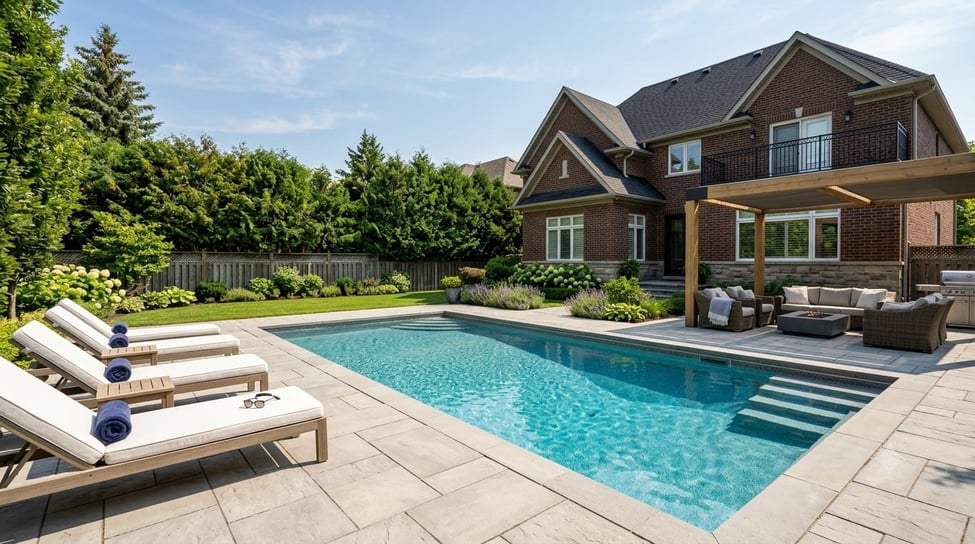
Buying a Home With a Pool in Ontario: The Real Costs, Resale Value Data, and What to Check Before You Offer
A home with a pool sells the dream better than almost any other feature in Ontario real estate — and it also creates more post-purchase surprises than almost any other feature if you don't do the diligence properly. Buyers who purchase pool homes without understanding the annual carrying cost, the resale value reality in their specific market, and what a professional pool inspection actually covers are the ones who spend year one discovering what year two is going to cost them. This guide gives you the complete picture: maintenance costs by pool type, the insurance premium increase you should budget for, the resale premium data by GTA city, and a checklist of what to have inspected before you offer on any Ontario pool property.
Looking for homes with pools in Milton, Oakville, or Mississauga? Reply to this email or book a free 15-minute call with Nik — we'll walk through which pool home listings make financial sense for your budget and carrying cost tolerance before you fall in love with a property that doesn't pencil out.
Step 1: Annual Pool Maintenance Costs in Ontario — What You're Actually Signing Up For
The number most buyers receive from listing agents when they ask about pool costs is the chemical cost — typically quoted as "$50–$80 per month in summer." That number is real and it is also incomplete by approximately $3,000–$8,000 per year depending on pool type, age, and condition. Here is the full annual carrying cost picture for Ontario's three most common residential pool configurations.
- Inground pool (concrete or fibreglass) — $4,500–$9,000 per year
The most common pool type in Ontario's suburban GTA markets. Annual costs include: opening and closing service ($400–$700 combined), chemicals and water treatment ($600–$1,200 per season), electricity for pump and filtration system ($800–$1,400 per season), routine maintenance visits ($500–$900 per season), and the capital reserve that most owners don't acknowledge — liner replacement every 8–12 years ($4,000–$8,000 for vinyl liner pools), pump replacement every 8–12 years ($1,200–$2,000), and heater replacement every 10–15 years ($2,500–$4,500). Amortised over the pool's 15–20 year lifecycle, the capital reserve adds $600–$1,200 per year to the effective annual cost. A pool that costs $1,500 in a good year costs $8,000–$12,000 in the year the liner and pump fail simultaneously. - Above-ground pool — $1,200–$3,500 per year
Above-ground pools have lower chemical costs (smaller water volume), no significant capital replacement costs in the short term, and easier opening/closing logistics. The trade-offs are well-documented from a resale perspective: above-ground pools add minimal to no resale value in most GTA markets and in some cases create a negative impression for buyers who see them as a removal liability. If the above-ground pool is a genuine feature you'll use, budget for what it costs and enjoy it. If you're hoping it contributes to the home's resale value the way an inground pool might, that expectation is not supported by transaction data. - Saltwater inground pool — $3,800–$7,500 per year
Saltwater systems have lower annual chemical costs than traditional chlorine pools (approximately 40–60% less) because the salt chlorinator generates its own chlorine from salt. The trade-off is higher upfront equipment cost and the salt chlorinator cell replacement every 3–5 years ($700–$1,500). Net annual cost is typically $500–$1,500 per year less than an equivalent traditional chlorine pool, while providing a gentler swimming experience that many owners prefer. Saltwater pools have become the dominant new-build pool configuration in Oakville, Mississauga, and Milton in the past decade, which means an increasing proportion of Ontario's newer pool home inventory carries this configuration.
The checklist for homebuying due diligence is covered in depth in the GTA home purchase resiliency guide — the pool-specific section of that checklist is expanded in Step 5 below.
Step 2: The Insurance Premium Increase — What a Pool Actually Adds to Your Annual Policy
A residential swimming pool is classified as an "attractive nuisance" under Ontario property insurance law — meaning it creates a liability exposure that insurers price explicitly into home insurance premiums. Buyers who don't account for this cost in their carrying cost calculation are consistently surprised at renewal.
- Typical premium increase: $300–$900 per year. The range varies by insurer, pool type, fencing compliance, and existing policy level. Inground pools typically add more than above-ground pools. Pools with proper four-sided fencing, compliant gates, and pool alarms attract lower premiums than pools without these safety features. Budget $500–$700 per year as a reasonable midpoint for an inground pool addition to a standard Ontario home insurance policy.
- Fencing compliance is not optional — it's provincial law. Ontario's Safety Fence Act and many municipal bylaws require that residential pools be enclosed by a minimum 1.2-metre fence with self-closing, self-latching gates. Non-compliant fencing can void your liability coverage in the event of a pool-related injury claim — which transforms the insurance question from "what's my premium?" to "am I personally liable for a drowning?" When purchasing a pool home, verify fence compliance before closing, not after.
- Pool liability umbrella: worth considering. For pool homes in the $1.0M+ range, an umbrella liability policy (typically $1M–$2M in additional coverage for $200–$400 per year) provides meaningful protection against the low-probability but high-severity claim that a standard home insurance policy may not fully cover. Not required, but worth the conversation with your insurance broker at time of purchase.
Step 3: Pool Resale Value Premium — What the Data Says by GTA City
The pool resale premium question is the one where buyer expectations most consistently diverge from market reality. The short version: pools add more resale value in some GTA markets than others, the premium varies by property price point, and the premium is almost never large enough to justify the pool's installation cost as a pure investment. What a pool does do is narrow the buyer pool (buyers who don't want a pool are eliminated) and accelerate decision-making for buyers who do — which typically means faster sales and stronger competition when the market is active, but slower sales and more negotiation leverage in slower markets.
| City / Market | Est. Pool Premium vs Non-Pool Comps | Price Point Most Responsive | Notes |
|---|---|---|---|
| Oakville | +5–10% | $1.3M – $2.5M+ detached | Strongest GTA pool premium — buyer expectations at this price point include pool as a standard luxury feature |
| Mississauga | +4–8% | $1.0M – $1.8M detached | Lorne Park and Port Credit pockets show stronger premium; Meadowvale and Lisgar less so |
| Burlington | +4–7% | $1.1M – $2.0M detached | Roseland and Millcroft backing streets most responsive; Alton Village less so |
| Milton | +3–6% | $950k – $1.5M detached | Premium concentrated in Hawthorne Village and premium Scott/Harrison streets; entry-level Milton pool homes see minimal premium |
| Hamilton / KW | +2–4% | $800k – $1.2M detached | Weakest pool premium in the commuter belt — narrower buyer pool, less luxury expectation at prevailing price points |
The resale data confirms what experienced GTA agents observe consistently: pool premiums are price-point dependent, not universal. A pool on a $750,000 Milton townhome adds little to no resale value and may eliminate a segment of buyers who don't want the maintenance liability. The same pool configuration on a $1.4M Oakville detached in a neighbourhood where adjacent properties also have pools is effectively an expected feature, and its absence would be a relative negative. The premium isn't in the pool — it's in matching the pool to a price point and neighbourhood where buyer expectations include it.
Step 4: Which Ontario Cities Hold Pool Value Best Over Time
Pool value retention is not the same as pool resale premium. Retention refers to how much of the pool's perceived value holds over time as the pool ages and as buyer preferences evolve. Three factors determine which Ontario markets retain pool value most effectively:
- Neighbourhood pool saturation. Markets where a high proportion of comparable homes already have pools are the strongest for value retention — the pool is a neighbourhood standard rather than a differentiating feature, and buyers researching those areas are pre-filtered for pool acceptance. Oakville's southeast quadrant and the Lorne Park / Clarkson corridor in Mississauga have the highest pool saturation in the GTA commuter belt and correspondingly the most stable pool premiums.
- Lot size relative to pool footprint. Pools on lots where the pool dominates the usable yard — common on the tighter 35–40 foot lots in newer Milton and Brampton subdivisions — lose value more quickly than pools on 55–80 foot lots where there is meaningful lawn space remaining. Buyers with young children in particular actively penalise pools that leave no usable outdoor space beyond the pool deck.
- Pool age and condition at purchase. A 5–8 year old properly maintained fibreglass or concrete inground pool with recent mechanical service holds its value well. A 20+ year old vinyl liner pool on an aging mechanical system is approaching its capital replacement cycle and is priced by informed buyers as a liability rather than a premium — even if the listing presents it as a feature.
Step 5: The Pool Inspection Checklist — What to Have Checked Before You Close
A standard home inspection does not cover a pool in sufficient depth. Always insist on a dedicated pool inspection by a certified pool inspector — budget $250–$450 for a thorough pool-specific inspection that covers the following:
- Shell integrity. Concrete pools should be inspected for cracks, especially in the floor and around the main drain. Fibreglass pools should be checked for delamination, blistering, and oxidation. Vinyl liner pools require liner age verification — a 12+ year old liner is approaching replacement.
- Pump, filter, and heater condition and age. Request the service history. A pump with no service records and no known age is a replacement risk within 1–3 years. The heater is the most expensive single mechanical component — confirm age, fuel source (gas vs electric vs heat pump), and whether it has been recently serviced.
- Electrical safety compliance. Pool electrical systems in Ontario are subject to ESA (Electrical Safety Authority) requirements including GFCI protection on all pool-adjacent circuits, bonding of all metal pool components, and proper grounding. Non-compliant electrical presents both a safety risk and an insurance liability. An ESA inspection or electrical inspection component within the pool inspection is worth requesting.
- Fencing compliance. As noted in Step 2, Ontario law requires compliant four-sided pool fencing. Measure fence height (minimum 1.2 metres), verify self-closing and self-latching gate operation, and confirm that there are no non-compliant access points — including gates that open inward rather than outward, which violates Ontario pool fence requirements.
- Permit history. Inground pools in Ontario require a building permit for installation. Request confirmation that the pool was permitted — unpermitted pools can create issues at sale and potentially require remediation or removal orders from municipalities with active enforcement. Most Ontario municipalities allow permit retroactivity, but it's a cost and complication you want to know about before closing rather than after.
- Plumbing — leak test. A pressure test on the pool's underground plumbing lines confirms whether there are leaks in the return or suction lines. Underground plumbing leaks are expensive to repair ($3,000–$8,000+ depending on location) and are not detectable by visual inspection. This test is particularly important for pools that have not been opened recently or where the seller cannot confirm the pool "holds water."
- Deck and coping condition. Concrete or paver pool decks develop cracks and settlement over time. Coping — the cap stones around the pool perimeter — can separate from the pool shell and become a trip hazard and a moisture ingress point. Both are repairable but both cost money. Know the condition before you offer.
The pool home purchase I consistently advise buyers to walk away from is a well-presented property where the pool was installed in 1998–2005, the vinyl liner has never been replaced, and the seller is quoting the pool as a premium feature with no recent service records. That is a $15,000–$25,000 capital replacement event within 2–3 years of closing — liner, pump, potentially heater — that is not reflected in the list price. The pool home purchase I consistently advise buyers to target is a 2012–2018 fibreglass inground with a documented annual service history, a saltwater system, and proper fencing — on a lot where the pool leaves at least 25–30 feet of usable lawn beyond the pool deck. That configuration gives you a pool that works, costs what it should to maintain, adds genuine value in resale, and doesn't force you to choose between the pool and a functional backyard. The age and service history of the mechanical systems are the variables that separate a pool asset from a pool liability.
Browse Homes With Pools in Milton and Oakville
Active listings filtered by pool feature in Milton and Oakville — the two GTA markets with the strongest pool value retention and most active pool home inventory.
Milton Homes With Pools → Oakville Homes With Pools →Or book a free 15-minute call with Nik — we'll walk through which pool home listings are genuinely priced correctly and which are pricing in a pool that's about to cost you $20,000.